Writing
Cindy Baker’s Fashion Plate

Through the wide picture window of the Drake Hotel’s coffee shop I could see Cindy Baker and Megan Morman sitting at a large harvest table. I walk by this window often, sometimes several times a day. Normally, this table accommodates tiny hipsters in trucker baseball hats with svelte lap top computers, nibbling on pencil tips (I sometimes wonder if this is their lunch). For two weeks in the summer of 2005, the normal patrons made way for a messy hub of alternative activity that was Fashion Plate. For the performance, the large table was covered with fabrics, notions, sketching paper, assorted drawing utensils and pattern books. At one end, Cindy was talking with unsuspecting patrons of the café as well as a few intentional performance art lovers who were curious as to what Ms Baker was up to (she has performed before in Toronto so there was some expectation and excitement about this performance). At the other end of the table sat Megan Mormon, Cindy’s partner and her assistant for this project, behind a sewing machine working with great concentration on a seam and juggling the duo’s receipt book used for keeping track of their fashion orders. For Fashion Plate, the audience was invited to design an outfit for Cindy. Some of the participants sketched a design for a single article of clothing and others created plans for entire outfits. Pattern books and fashion magazines were scattered on the table for inspiration. In her original artist statement, Cindy says she wanted the participants to come up with something from scratch: “translating what they like on their body to hers, or ‘sizing up’ the artist’s size, taste, and personal style and decoding it from abstract idea to 3-dimensional design”. The plans that the visitors made were given to the artist and assistant to sew and make into clothing. This project produced a total of 30 items of clothing over the course of 2 weeks and culminated in a fashion show. What is activist, practical and for some even interesting about this performance is that Cindy is fat.

My PhD dissertation is about fat activism and fat bodies. Furthermore, I headed up and worked with the performance and education troupe Pretty Porky and Pissed Off for 8 years.(1) I am ready to write about Cindy Baker. But this research, prep and experience did not wholly prepare me for what I found when I encountered Cindy and Megan at the Drake Hotel one hot summer afternoon.

What is striking at first with the performance of Fashion Plate is how much space these women take up in the café. It is noteworthy that their fat bodies and all the stuff that they’ve brought seem to mess up the space of the Drake coffee shop – who belongs and who does not. The amount of space they are taking up is relative to the context that they are located. One of my complaints about the Drake has been its clientele of “beautiful people”. You know the type – movie stars and fashion models – and the very body fascism that attends this type of crowd and the insecurities that the spaces occupied by those who fit into those kinds of body standards bring up for the rest of us normal, ugly, fat folk. When I first see Cindy and Megan through the Drake window – I think: Yes!! The fat girls are taking over the Drake. The presence of their active fat bodies temporarily transforms the meaning of that space for me.

The second striking element of Fashion Plate is Cindy’s fat body. The practical process of the performance demands that her fat body be looked at. People have to measure and consider her rolls and girth in order to create the patterns for the clothing that she sews. Some of them did the actual measuring. Others, who participated on a less active level, had to watch her get measured and move around. Cindy speaks about this secondary participation in an email conversation with me a few months after the performance:

For those who didn’t actually make something, they were still confronted with watching others do this awkward dance with me, got to see the process of the garment’s creation, got to hear the conversations. I estimate that for every person that made an article of clothing there were 10 others that I had individual conversations with that covered a range of topics from body politics to women’s rights to performance art to fashion design, and way beyond. I really feel like just because someone didn’t make something, it doesn’t mean they didn’t actively participate in the project.

The attention she got was obvious, as her performance space is lively and demands a lot of attention. She is undeniable.

Arguably the bodies of fat women are caught in a strange double existence of simultaneous invisibility and hyper surveillance. If they are regarded they are watched and judged and held up as examples of excess without subjectivity (think of the headless bodies of fat people, used to strike fear regarding obesity epidemics, that we are familiar with seeing on the nightly “news”). These are sneaky looks at fat bodies. One of the only other occasions that we “see” fat bodies in the media are in before and after shots for diet ads or television shows like “The Biggest Loser” or (the thankfully cancelled) “Fat Actress” which are about getting people out of the subject position of fat as quickly as possible. For Fashion Plate, Cindy asks the visitors to actually consider her fat body as a lived reality – not as a problem necessarily. Audience members engage with it and participate in it via clothing. I watch as visitors finger and look at the swathes of cloth and size up Cindy. Cindy’s body at time of performance seems to sit in the category (what we call in fat activist circles) as super size. She is a real fat girl – not just chubby or chunky or “feeling fat” as some of the smaller patrons in the café may “feel” and complain about regularly (familiar with the following question: “Do I look fat in these pants?”) Cindy looks, is, and embodies fat.

In her artist statement, Cindy talks about how this project gives people permission to look at her, and to practically size her up. The challenge for her is to be looked at in a manner that she assumes will be “critical”. Part of the purpose of this project is to get people to consider fat bodies outside of their normal framework. In a previous performance titled Glass Box, Cindy walked around in a giant clear plexiglass case. While the strategy of the performance was to draw attention to the vulnerability and protection of the artist, I can’t help but see it as the visibility and the erasure of the fat body as Cindy paraded through public spaces in a protective plexiglass box with sharp edges. Viewing her body through the box in the context of the mall, the street and the park was about allowing people to look at her and also about forcing the private experiences of the body into the public through this display. In Fashion Plate, Cindy is making people not only see her, but also think about her body in a more complex way. She employs the position of fashion model as a strategy to force her audience into a place where they are the artist/designer. By including the audience in this construction it means that they have to think about her body and the object they are creating with a sense of pride. What will provide a sense of accomplishment is if the clothing fits and Cindy looks good in it. Their mission was to make Cindy look beautiful. This is not a project that most people are used to taking on in relation to fat bodies.

Cindy’s performance is about making her body visible — literally forcing people to consider it. Baker’s excitement at the success of her performance comes from moments when participants figured out something about her body in relation to the clothing they were designing. She recalls moments when they may say something like “Oh! I get it, that crease goes way deeper than I thought.” For Baker, this represents “some honesty on both our parts, because we were both letting our guards down and being a bit vulnerable, one in displaying her body and the other in displaying her ignorance.” It is this ‘realness’ of reaction or the letting down of one’s guard that Baker is after with her performance. The outfits and the materials are all just a ploy for her to get to see small crumbs of people’s real and unfettered reactions to her body. One of her most favorite (and she adds horrific) moments of the performance was during the final fashion show, when some of the audience members could not hide their reaction to her body in a skimpy bikini. Baker says:

[W]hen I came parading in wearing Leif’s bikini or some other skimpy dress, people’s gut reactions were painted on their faces. It was the one time where I felt like “Yes! Some honesty!” That’s what made it satisfying; there were lots of really supportive people and lots of positive reaction, and I felt confident, but the best part was that there was still visible proof that the problems I was raising through the performance really do exist, and that I hadn’t just created a bubble of support around me that shielded the rest of the world from having to deal with it at all.

In retrospect, Baker talks about being surprised at how much her body was actually a part of the performance. It is as though her body in theory, in grant applications and performance proposals is nothing like her lived body in the moment of the performance. What gets lost on paper is the emotional experiences (both joyful and traumatic) that become much more poignant in the moment of performance. It seems as though Cindy’s performance forced her to see and be in her body in ways that she is not necessarily familiar with in public contexts.

Cindy did not anticipate that her work would be received by willing participants who were open to getting their hands on her body. In our interview she claims:

…one thing I could not predict was that those who were willing to engage did so wholeheartedly, and were not afraid to get their arms around me, to wrap me in fabric, to hold things up to see how they’d look. I thought I’d be more of an active participant in the process than I often ended up being; in many cases, I was asked to stand, lift up my arms, turn around – to be a mannequin.

While I could make the obvious connection between Cindy’s body and objectification, my experience at the performance suggested to me that there is more to it than that. Like Cindy mentions above, people were interested in engaging with her and talking with her as well as, for some, getting their hands on her.

Fashion Plate is a blend of performance and object-making. Baker claims that the most important part of the project is what happens between her and the people she connects with through conversation and negotiation. She wanted to find out about what she calls in her artist statement “the things that were avoided as well as the things that were covered. Each garment tells its own story, but it is the final product; the rack full of clothes, the finished collection – that has the potential to demarcate trends or reveal truths”.

Cindy was surprised by the kind of clothing that people were interested in designing for her. Rather than practical clothing (and this may speak for the kind of people willing to participate), people were interested in making what she calls “contemporary art clothing”. She says: “Instead of trying to make something that fit by selecting a simple design, they pulled out all the taffeta and the organza and made the most elaborate designs and really tried to make me into their diva.” This may be one of the ways that people are actually able to consider the fat body – as spectacle. Cultural theorist Mary Russo (1994) makes this point in her analysis of the articulation of female subjectivity by performance artists who use the grotesque. Basically, if our frame of reference for fat bodies is diva, clown, or freak show fat lady, this would explain why some of the clothing designed for Cindy emphasizes babyish or clownish characteristics. Russo and other academics that consider the fat body such as Probyn (2000) and Le Besco (2003) point out that one of the only ways to actually celebrate fat is to do it in a kind of over-the-top, carnivalesque, grandiose way rather than as “normal”(2). Trying to articulate fat as normal is actually quite complicated because of the meanings that the fat body is laden with. The case could be made that celebrating the fat body is a special occasion rather than an every day event. Still, sometimes a useful and practical blouse or trousers are way more important than a taffeta dress. In reworking meanings attached to fat bodies there is a fine line between clownishness(3) and dignity.

I understand the impulse to make and decorate a fat body like birthday cake. This has been a strategy of Pretty Porky and Pissed Off. The literal translation of “joy” attempts to celebrate the fat body given the visual tools that we have – we called it fat drag. In this way I am consciously utilizing Judith Butler’s early theories about gender and performativity in relation to drag culture, which highlight how gender itself is a copy. In Bodies that Matter (Butler 1993), she looks at how othered sexualities challenge gender fixity. By looking at concepts of the lesbian phallus and cultural phenomena like drag (through the film Paris is Burning) she critiques “normal” gender by looking at drag performances. Fat drag, I argue is a way of “doing fat” that emphasizes its constructedness rather than inherent givens. For example, Baker, by wearing a muu muu that is way over the top is donning the classic attire of “the fat woman”. She is marking her body as fat. She is performing fatness in a way that is “knowable” to the general population. However, when she sports a bikini, she is definitely stepping outside of the boundaries of what a fat woman is supposed to wear or how she is supposed to present herself. When she does this, she is subverting the fixity of fatness. She is shaking it up by subverting it and drawing attention to flesh and the constrictions of it in the same ways that drag queens and kings critique “normal” gender. Baker is challenging “normal” bodies and in effect using her body and her clothing line to demonstrate how “thinness” or “normal size” are also performed. Fat is not the imperfect copy of the proper body. There is no proper body, and fat is.

Performativity works to “produce that which it names” (Butler 1993, 2). That is, “naming it” is making and doing gender. Simply put, performativity theory claims that “saying” makes something come to being. More complexly, performativity is how the subject comes to know itself – it is how we are able to articulate “I”. Generated through speech act theory such as this, claiming “I am fat” can be revolutionary, while simultaneously hearing “You are fat” can be oppressive. Both statements can work to empower or oppress. Both statements are constitutive of identity. What happens when the fat woman asks the “normal bodied” person to design clothing for her? She, and they, are acknowledging that she is fat. Because of the unavailability of clothing in larger sizes, they must make clothing for her “abnormal” body that mirrors “normal” fashion in some way.

The complexity of Fashion Plate is that Baker asks participants to consider the fat body in relation to their own. Which means that I would like to ask some of Baker’s designers: Would you wear that dress to the party? Could you wear that shirt to a job interview? Do you think that Cindy conveys confidence and cool sexiness with what she is wearing? The answer is no to the majority of the outfits that were designed for Cindy. Crazy and beautiful – yes. Practical and usable by this fat bodied woman in her everyday life – no. This lack of practicality is an observation. It is not necessarily a failure of the project. It is the failure of people to engage with the practical realities of fat bodies. One of the main purposes of Fashion Plate was to get people to think about fat bodies in relation to their own (the majority of the designers were not super size). It is telling that given the opportunity to do this they designed clothes which are actually further away from probably anything they would ever wear in their own lives. I would argue that they did in fact consider Cindy’s fat body in relation to their own and when pushed to contribute to the creation of an object in relation to Cindy’s body, because of fat phobia, they made something that was really quite distanced from their bodies(4). It is the kinds of revealed truths that are found in the impracticality of her designed outfits that are the quiet success of Baker’s project from this fat activist’s perspective.

My own design contribution took into consideration some of my learned experience as a fat woman as well as my immersion in fat culture for the past 10 years. I know that fat girls have difficulties negotiating body visible areas such as swimming pools, fitness clubs, beaches and dance clubs. I wanted Cindy to have a bathing suit that was totally cute and that she could wear to the beach in a fat body – that means a top that could hold her boobs up and a bottom that covered her butt. I also considered Baker’s career as an performance artist and figured she could handle her midriff showing, so I made it into a bikini – arguably not practical, however – revolutionary for a fat woman to wear in public in my imagination.

In the research for my dissertation I interviewed 15 women who identify as fat and asked them to talk about how they move through the world in their fat bodies. One of the most cohesive findings in my research is that fat women have a lot of difficulties clothing their bodies. Furthermore, the experience of shopping is not positive. In terms of space, the clothing store, and more particularly the change room, are often sites of oppression for fat women. For many it is the location where they first learned they were fat and that fat is wrong – often seeing themselves through the disappointed eyes of a “well intentioned” mother or sales person. The clothing change room is a site of disappointment, anger and frustration. One of the elements that I find the most exhilarating about the Fashion Plate performance is asking “normally” sized bodies to consider a fat body and lovingly and excitedly dress it. I am/was also astounded at how Cindy bravely transformed the space of the Drake Lounge into a public change room. I don’t mean that she changed in front of people. She changed in privacy. But she paraded around in her fresh new outfits in front of the judgmental eyes (replacing the mean moms, shoppers and sales people). By doing this, Baker takes this seemingly universal fat experience literally out of the closet. Those who are able to take this idea in can access how profound this kind of feminist intervention is. Cindy turned that space inside out. As an audience member during the fashion show I felt terrified and triggered. I wanted to protect Cindy. I cringingly watched the Drake clientele either ogle or consciously ignore Cindy as she paraded through the hotel in her new tight and often skimpy outfits. We are not used to seeing the flesh of fat bodies in public in this way. The only time I’ve seen the kinds of corporeal realities that Baker exposed has been at the YWCA change room (a life transforming experience) and in spaces that have been marked by activists as fat positive by the bodies that are there and the performance that takes place.(5) The unveiling of Cindy’s outfits in the pretense that it was a fashion show (and it was) was actually quite a solemn affair. The smallish crowd that had gathered to witness Cindy’s performance tried to overcompensate with clapping and cheering but there was little interaction between the audience there to observe Cindy – “the converted” as she refers to them – and the groups of people who just happened to be in the space. But, according to Baker, this is truly what she wanted from her performance – some real reactions to her body. For many people the realest reaction was ignorance in all its forms – I’m not surprised and neither is Baker.

I am looking forward to Baker’s next endeavor, which promises to create an even bigger spectacle and will taunt her audience even more – denying them the opportunity to turn away. For the aptly titled: Personal Appearance: Performing Self Cindy Baker, she is constructing a professional mascot costume of herself. Similar to other amusement park and sports team characters, Cindy’s mascot will be cuddly, goofy and supposedly approachable. In her artist statement, Baker theorizes that the mascot will:

function to erase social barriers and encourage physical contact and play, as well as the building of emotional bonds; it will therefore allow me further and more complex access to my study of people through allowing them to study me.

Will Cindy’s mascot of herself be sweet or will it be monstrous? Hopefully, it will be both – my favorite flavor.

(1) “Pretty Porky & Pissed Off was not initially conceived of as a performance group. Rather, the group endeavoured to raise awareness in other ways, such as protesting, conducting educational workshops, engaging in group consciousness raising, and other activities. The group evolved, and in addition to these activities, they also eventually produced zines, held fat girl clothing swaps, performed street theatre, as well as more formalized performance work that could be classified as ‘cabaret style’, meaning it encompassed a variety of performance styles, such as monologue, dance, storytelling, singing and fat drag. While multi-faceted, the activist performance repertoire of PPPO’d is all geared towards one central goal: raising public awareness and consciousness about body issues and fat phobia”. (Pinterics, 2005 pp. 178-9)

(2) I would like to draw a parallel as well as underline the danger in normalizing outsider or marginalized identities and sexualities – and arguably occupying fat as a position of pride or even happiness is outside the mainstream ideals of loathing, fearing and hating fat. However, as is the case with most identity-based politics, fat activists have expressed fear of losing the radical politics based in their identiies with the homogeneity of normalness (Cooper, 2005). Think about the arguments by some queer activists against gay marriage, for example. The fear is that normalizing outsider identities in fact erases the very differences that make them unique and interesting or resistant in the first place.

(3) There is a historical legacy that has existed at least since the turn of the century which has associated fat bodies and fat people with clownish behaviour in white North America. This topic is considered thoroughly in at least two collections of essays by Braziel and Lebesco (2001) Bodies Out of Bounds: Fatness and Transgression and Kulick and Meneley (2005) Fat: The Anthropology of an Obsession.

(4) This is not unequivocal. Some of the outfits actually looked like the people who designed them, for example, Paul Couillard’s muu muu, Vera Frenkel’s multi layered gown, Istvan Kantor’s neoism uniform and Leif Harmson’s bikini. Making Cindy into the larger doppelganger of these famous artists, offers an entire other psychoanalytically based essay about ego and creation – the desire to see the self blown up larger than life….

(5) Here I am thinking about fat cabarets like Chubbalicous (2001), Blubber (2001), Double Double (2002), Big Cindy [ironically titled in relation to the work of Cindy Baker but it was not originally titled with her in mind] (2003), No Lose (2004-5), and Chub Rub (2006).

++++

Works Cited:

Baker/Mitchell email interview, February/March, 2006.

Baker, Cindy, Fashion Plate artist statement, Fado website

Baker, Cindy, Personal Appearance: Performing Self Cindy Baker (unpublished)

Bazeil Jana Evans and Kathleen Lebesco, 2001, Bodies out of Bounds: Fatness and Transgression. Berkley: University of California Press.

Butler, Judith, 1993, Bodies that matter: on the discursive limits of “sex”. New York: Routledge.

Cooper, Charlotte, 2005, Plenary Speech at NoLose conference, Newark New Jersey, available at www.charlottecooper.net.

Kulick, Don and Anne Meneley, 2005, Fat: The Anthropology of an Obsession. New York: Tarcher/Penguin.

Le Besco, Kathleen, 2004. Revolting Bodies?: the struggle to redefine fat identity. Amherst MA: University of Massachusetts Press.

Pinterics, N. 2005. Big & Bawdy Bodies: A Feminist & Cultural Studies Analysis of Fat & Frisky Performances. MA thesis, Mount Saint Vincent University.

Probyn, Elspeth. 2000. Carnal Appetites: FoodSexIdentities. London: Routledge.

Russo, Mary. 1994. The Female Grotesque: Risk, Excess and Modernity. New York: Routledge.
Writing
From Ironic to Iconic: The Performance Works of Tanya Mars

Edited by Paul Couillard
Design by Sameer Farooq/New Ink
2009, 286 pp. (32-pp. colour section) with index
Includes DVD documentation of Mars’ performance Tyranny of Bliss

With articles by: Paul Couillard, Tagny Duff, Jennifer Fisher, Randy Gledhill, Nelson Henricks, Will Kwan, Paul Ledoux, Joanna Nash, Jennifer Oille, John Oughton and Pam Patterson, Andrew James Paterson, Kim Sawchuk, Dot Tuer

Tanya Mars has been a key figure in Canadian art since she burst on the scene in 1974 with her first groundbreaking exhibition, Codpieces Phallic Paraphernalia. Provocative and political, Mars has relentlessly shown us that the way to the jugular is through the funny bone, creating a series of compelling “three-dimensional pictures” that have made her one of Canada’s most acclaimed and important performance artists. This anthology offers a comprehensive look at her career, including a DVD with photo and video documentation of many of her major works.

An innovative leader in the performance art scene here and internationally, Tanya Mars makes art that is courageous, humourous, operatic and original. Ironic to Iconic gives the reader a cogent and too little-known background to Mars’ career and her role in the development of performance art in Canada.
~Jessica Bradley, curator and director of Jessica Bradley Art + Projects

Writing
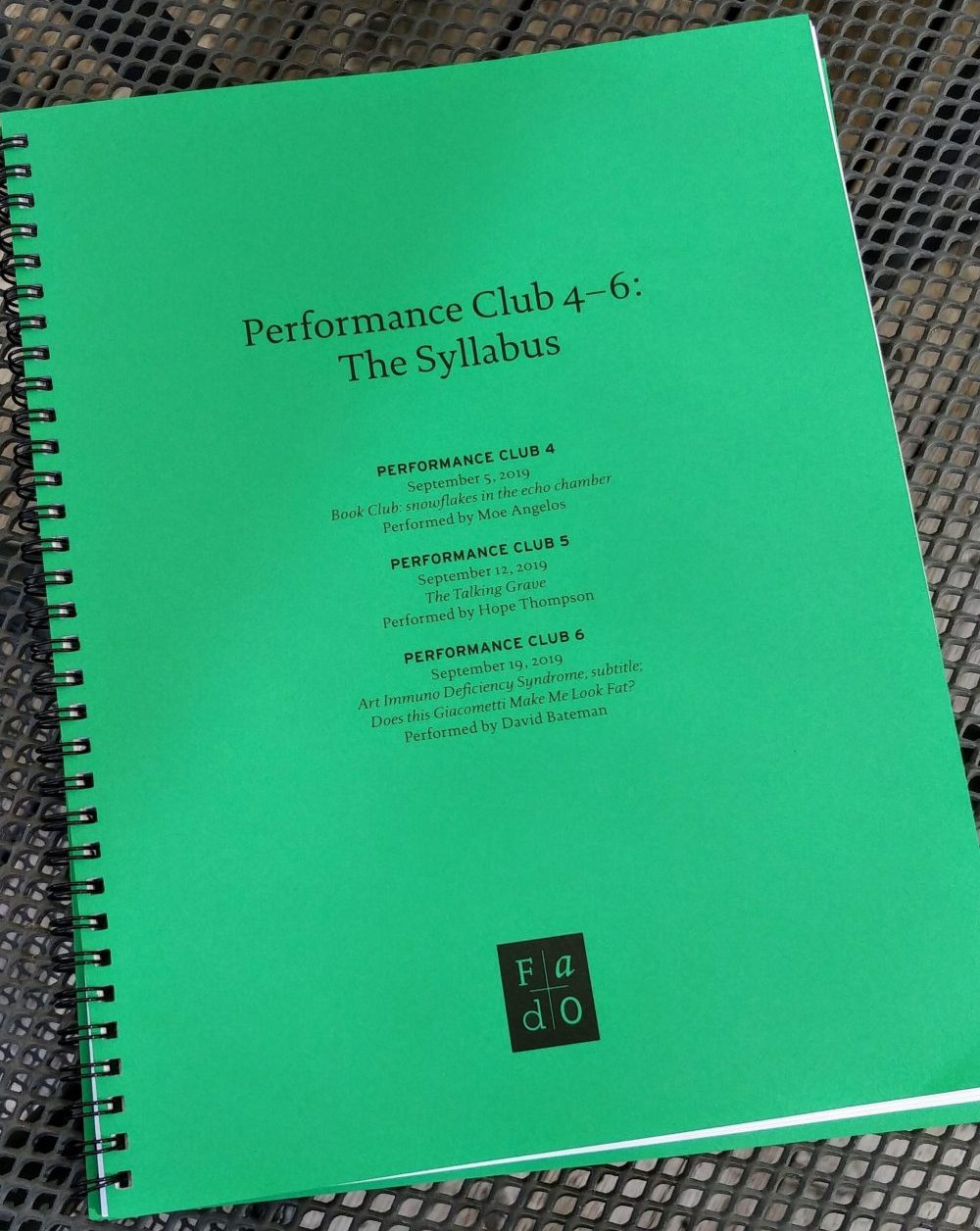
Golden Book 6: Performance Club: The Syllabus

The sixth in the Golden Book series and essential reading for the performances presented in FADO’s Performance Club series, Performance Club: The Syllabus contains everything you need for your Performance Club 4–6 experience (including that pesky homework).

TABLE OF CONTENTS

1. This is a Queer Series
Introduction by Moynan King

2. Queer/Play
By Moe Angelos

3. Three O’Clock
By Cornell Woolrich

4. I Wanted To Be Bisexual But My Father Wouldn’t Let Me
By David Bateman

Designed by Lisa Kiss Design
72 pages

Writing
Arborite Housedress Script

Prologue

This is about a domestic love-affair between myself and advanced interior decorating technique. This is about the in-between of my placement, of my desire. Me, in-between: wallpaper valances, contrasting trim, kitchen islands, ferns.

This is about me, trying to make the look work; me, wanting it to all hang together; me, giving it that je ne sais pas; and me, getting the details right, the little things, the finishing touches.

Oh, oh and that feels so…hard.
Oh, oh, oh, and I’m so very…pointed.
Oh and yes and oh…I think I’ll… clean up a bit.

Introduction

I am so clean! I am so white! I’m so up, pro, up, pro, up on life!
‘Cause I’ve got a contract, a done deal, signed (clap), sealed delivered
And I’m his.
I’ve been chosen for the whitest, brightest smile.
I’ve been saved, because sin won’t stick to me.
I’ve been taken and it’s about time, too.
I’ve got this contract,
This marriage contract, signed (clap) to him in the big white robe,
Signed (clap) over to his slightly crucified but still attractive son,
And signed (clap) again on earth with ink on paper making me third-hand goods,
A-signed (clap) to a man in the flesh who mows the lawn.

There are so many things that I know, because he says so.
And he should know because he makes them happen.
The weather, that’s him.
American foreign policy, that’s him, too.
Natural disasters, prime-time programming, he does it all
His way.
A real self-starter, a self man-made
In his own image:
The weather, American foreign policy, natural disasters, prime-time programming,
And me.
Not bad, eh?
Not too shabby.
Kinda scary!
I mean, I wouldn’t want to get on his bad side, no.
Because the dark side of good is really bad.
I know, because I’m so good.
I’m so clean! I’m so white! I’m so up, pro, up, pro, up on life!

Marriage

Marriage is a lot like driving a car. Let’s say you’re going on a little trip, just the two of you. You pack your bags, jump in, and go. Now, how many of you are sitting behind the steering wheel? How many of you are actually doing the driving? That’s right, only one of you. There’s only room for one person in the driver’s seat. And what does he do? He controls the direction and speed of the vehicle. He indicates which way he’ll be turning and he toots the horn. In short he carefully maneuvers the car for the good and safety of all of the passengers. But that doesn’t mean that the co-pilot isn’t very important, too. When there’s two people in the car, she reads the map, finds the best radio station, provides pleasant conversation, and passes snacks to the driver. She has a very busy job, but she is not driving. In fact, what would happen if she reached over and grabbed the steering wheel? What would happen if she suddenly decided it was her turn? The car would go out of control, wouldn’t it? Even if she just leaned over to flick on the headlights, even that would startle the driver, and he might get into an accident. This shows us a very important point. When people don’t do what they’re supposed to do, when people don’t stick to their jobs, they end up hurting not only themselves, but others as well. Let’s take a look at Adam and Eve in the garden. When Eve took that apple, who was in the driver’s seat? And where did she end up driving them? You know where. Down a one-way freeway straight out of paradise. Eve took a wrong turn. But her big mistake was taking the wheel in the first place. Not only did it have serious repercussions for her, her family, and the entire course of human history, it also made Adam feel bad. Not only was it an extremely dangerous thing to do, it also hurt Adam’s feelings. And that’s not very nice, is it? It’s not very nice, and it’s not very smart. Because the driver can get in the car alone, and still start it up and make it run. He might get a little lost, he might not get any snacks, but he can still get up and go. Whereas the co-pilot, when she climbs into the car by herself, ends up spending a lot of time in the driveway, just reading those maps.

Bridge

The dark side of good is really bad.
I know, because I am so good, so clean, so white
That every dirty thought shows up bright-
Ly on my immaculate construction.
Every dirty thought can be read like an open book
Spelling what I want and how I want it, when.
Words you see scratched on bathroom walls.
Words you’re embarrassed to know.
Humiliating, needy words
Show up
On my complexion.

Romance Novels

My fantasies exist between the pages of paperback novels published every four days in fourteen languages for an average cost of $4.95…Canadian.
Reading Windswept Summer, Nurses’ Folly, or Indiscretion at Midnight
In Punjabi, Cantonese, or Cree
Is the only reason I can think of for bothering to learn another language.
Those foreigners, the way they speak,
It’s as if they’re always yelling.
But I’m sure that those languages wouldn’t sound so bad
Tripping from the lips of
Clark Cowell, Troubled Millionaire,
Whistled from between the teeth of
Flint Blackwell, Brilliant-But-Lonely Surgeon,
Or whispered by
Jon (that’s J-O-N) Johnson, International Explorer, Oxford-Educated, Hunk-A-Burning-Love, who has a Six-Figure Annuity and has Never Really Loved Before.
I know this is awfully liberal of me to admit
But if Jon Johnson was willing to take me
To his ancestral castle in the south of France,
Make love to me for hours every day,
And ask me what I think from time to time
I wouldn’t mind if he spoke Lebanese, or Zulu, or…French.
I really wouldn’t mind too much.
I wouldn’t mind a bit.

Fantasy #1 – Border Town Romances

Fantasy #1: Border town romances (twirl).
What makes border town romances so…special?
The meeting of culture? The mystery of difference?
The preciousness of each and every moment?
Or is it the pain of longing? The difficulty of talking?
The disapproval of one’s family and friends?
Perhaps it’s that they only exist in the present.
You probably won’t have time to discover each other’s personal habits.
Taking out a mortgage together just isn’t in the cards.
And across that border you have a better chance of being shot, than of getting pregnant.
It makes sex seem less risky.
It makes sex seem more fun.
It makes you feel that the border doesn’t really exist.
Your love is stronger than its walls.
Your love transcends all obstacles.
Your love is absolutely, positively unique.
While it lasts.
Oh, you know it can’t.
It’s impossible. It’s insane. It’s…O.K.
You have an out. An escape hatch. Fine print.
Because forever is really an awfully long time.
Forever takes too long.
And it all becomes the same after awhile:
On and on and on without end.
So, if you’re lucky, it’ll be tragic.
It’ll be epic, yet it’ll be quick.
Your love will be spectacular from start to finish.
And afterwards you can cry and cry, grieve and remember.
You’ll live with your memories
And you have more time to shop for other things.

Bridge

My fears in life are few and far between:
Saturated fat,
Communism,
And GRAVITY.

Sagging Flesh

A woman’s foundations are exceedingly important in an increasingly gravity filled world. This sneaky phenomenon—gravity—this downward pull that threatens my very concept of up and down, replacing it with lower, lower, lower; this force is actively conspiring against us for no other reason than spiteful adherence to some banal law of physics. It’s a bit of a downer, to say the least. As I find my flesh collecting in puddles at my feet, my nipples lolling in hard to find places like corners, under beds, beneath bric-a-brac shelves, constantly getting stuck in the hose of my vacuum cleaner. But the real problem is not the extra housework that these downwardly mobile body parts entail. I hesitate to admit it, but it’s true: my very real concern is that parts of my dangerously sagging self might end up in bad neighbourhoods. And what then? How could I fight? There’s no bleach strong enough to save my shimmering self. I could scrub and scrub and rub and rub, but those streets, those people will never know sparkling, lemon fresh, central vac, and snow white appliances. How could they? Their ways are uncertain and unsafe, not even aware of the dirt under their nails, the bacteria populating their surfaces, their skins dark and shadowy. They may be happy in their ways, but how could I manage among them? Surely no better than they among us.

These are the thoughts that keep me awake nights worrying, that stain my dress with rings of nervous perspiration throughout the day. For it seems not improbable that bits of my body might end up there, on the wrong side of the tracks. And therefore to continue to believe that the line between “me” and “them”, “same” and “Different” is firm and perky would be naive. Especially when the stretches and wrinkles in my skin illustrate how fluid my own borders are. So perhaps it’s alarmist, and perhaps it’s not, but I cannot sit idly by and await this prodigal fate. I must women my defenses and women them well; batten my hatches, and buckle and snap myself into underwear that binds and separates, having painfully evolved from lingerie to veritable architecture.

Bridge

My fears in life are few, it’s true,
But my fantasies can’t be counted.

Fantasy #2 – The List

Fantasy #2: achieving everything on my to-do list (twirl).
As I suck dirt into my waiting bag of empty, clean space
As I fill the interior of my open-plan, decorator-deluxe hollowness
I think of curtain stays,
Grid suspended pot racks,
Self-feeding electrical cords,
And other time-saving restraints.
I can’t get enough of this dirt.
Frankly, it’s just not dirty enough for me.
But I’m trying to make do, trying to make out
Tiny specs that have fallen between my cracks
That I can come to on my hands and knees
And rub and scrub until I slip in the grease of my own elbows.
The dust and the grime of this house are mine
Traces of my body that I massage
With brushes and sprays and an entire array
Of highly toxic germ fighting solutions
To the problem of “a woman’s work never really being done.”
It sounds like a small thing to get excited over — dirt —
But then we are expected to get excited over little things.
And this proof of my untidy, ever-exfoliating self
Tells me I am here
I am real in this world of gloss
The mess I feel is real.
I know it—it is of me—and it knows me
Well.
It knows my flesh.
It knows, and it holds me there,
Bent over sinks,
Arms deep in toilets,
Crawling across floors
Wanting the dirtiness of dirt.
Wanting to take back the dirt.
Take back me.
Take it in.
Suck it in.
Lick it in.
Be in dirt.
Be in me.
Come in me.
Dirtily.

But I want it, I want it, I want it. All. Instead of this scary get-down, show down, between none other, is there anything worse, than saturated communism, and sneaky, pinko fat?

Marriage Quiz

One: Question. What makes marriage so attractive?
Two: Bigger student loans? A good excuse to move out of your parents home? Wedding presents?
One: No. I mean, why did you marry? What led up to your decision to join together in holy union?
Two: It seemed like a good idea at the time.
One: But haven’t there been benefits to being a married woman?
Two: Could you repeat the question?
One: Let’s try another one. When I say, “To have and to hold…,” you think of….
Two: Strangulation? Suffocation? The correlation between ownership and theft?
One: When I say, “‘Till death do us part…,” you feel….
Two: Homicidal? Suicidal? Resistant to the concept of reincarnation?
One: You’re not trying very hard. We’ll try again. Question. What does marriage mean to you?
Two: Infinite compromise. Sacrifice. Selflessness. Losing oneself entirely.
One: That’s better! And who is the most important person to remember in a marriage?
Two: Me! Him? (pause) God? (bells and whistles)

Fantasy #3 – Lesbian Nation

Fantasy #3: lesbian nation (twirl).
Being a domestic goddess isn’t all it’s cracked up to be.
Have you ever noticed that you can wash the floor in the morning, by nightfall it looks just the same as before you started? That you can do all of the dishes, and in a matter of hours someone has gone and dirtied them again? That children are little grime magnets, picking up all manner of stubborn stains and bringing them home again?

Well, I’ve been thinking. If I could get rid of my family, it would effectively cut my work load by 60%. And then I would finally have time to devote myself more fully to being a homemaker. Then I could start to get ahead in the domestic world. Make something of myself. Achieve those far off goals. Perhaps move up to a ranch style. Without PTA or connubial duties getting in the way.

And you know, I bet I’m not the only one. I bet there are hundreds, maybe thousands, maybe even millions of women who would also benefit from the absence of men and children in their lives. As it is now, think of all the wasted human potential. Think of how clean it could be, if we were all freed from the inconvenience of those to whom we are joined by blood and marriage. I, for one, would have more time to devote to the common good. I’d gladly spend a half-hour vacuuming the boulevard, and afternoon dusting a jungle-jim. I, and others like me, would getup our gumption and get out of the home to make the entire world a spic-er, span-er place. There’s no end to what we could acheive together. We could tidy up toxic waste sites! Redecorate urban decay! Sew some shoulder pads into the economy! Why it would be paradise! It would be sparkling! It would be the first lesbian, separatist nation!

Bridge

I’m so clean, I’m so white
I’m so crisp and hard and still and right
That every twitch and tremor I make turns out left or wrong
Proof positive of a strong predisposition toward voluntary hysteria.
I slice my palms on the creases of my dress.
Everything is so well pressed.
It’s a problem area.
I am a problem area.
This is the problem:

Conclusion

I am a domestic alter
Location of discipline, receiver of guilt
My lipstick (kisses palms) glows bloody
The wound in my side a testament
To the persistent pain of splinters
Chaffing me each time I try to move
In this bungalow that never fit
Right?
In the first place
There was Eve
Experiencing for the first time the downward pull
The long fall from grace to graceful A-lines
In no-stick, hi-gloss, easy-to-maintain finishes
To a place where everyone has the same blood-type: clean
And whiteness and Godliness
And might and right
And home and family
All tidily equal up
In a divine floor plan
Three bedrooms, sunken living room, patio off the breakfast nook,
Repeated over and over and over again
Tomorrow is another day
-Ly bread, our kingdom comes
Unlike me
In this straight jacket against desire
Where passion plays on TV
And we only communicate in clichés
Based on stories that only end badly
For me.

Writing
Exercise On Experiencing Ephemerality

The following performance exercise is by Marilyn Arsem. You can find it on page 192 of the new publication about Arsem’s work entitled Responding to Site: The performance work of Marilyn Arsem.

Exercise On Experiencing Ephemerality

In a course on documenting ephemeral work, I being by examining the reasons that we try to hold onto the past, as well as the ways that our memories are fluid and elusive. Early in the course I give this task:

  1. Chose a place nearby that you have always wanted to visit and see, but have not yet gone.
  2. Go there, taking as much time as you wish to explore and experience the place.
  3. Before you leave, choose one object to bring back as a souvenir. Only one.
  4. And finally, you must agree never to return to that place again.

Initially this exercise appears mundane, until the final stipulation of never returning is added. The most revealing part of the process is each student’s debate on where they will go, knowing that they can’t return. The ones that choose the place they most desire have the most intense experience, and those that play it safe and choose a place that has minimal significance for them have the least meaningful experience.

I designed this exercise in an effort to replicate the experience of making a performance or other ephemeral work, and the profound feeling of loss that can occur when it is over. In particular, I am interested in pointing out that this kind of work is not unlike one’s own life, in that you cannot return to the past, but only—and if you are lucky—save a relic or memory of it.

Writing
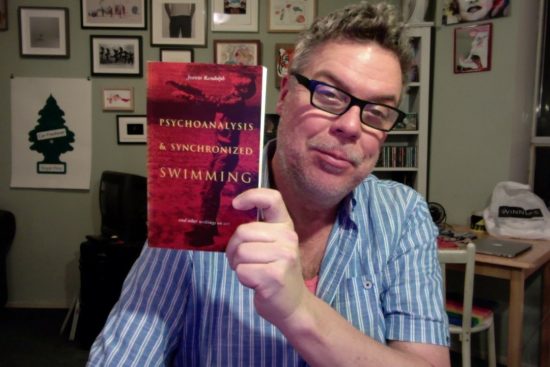
Notes on a High Tea

I’m not sure where any of this is going but don’t throw any of it out.
~Shannon Cochrane (heavily paraphrased)

Gallerist Paul Petro refers to my new association with Jeanne Randolph as a “forced mentorship.” He might be right. I’m not sure myself what this new relationship is. Given that Jeanne Randolph has been on my mind so much (I just mailed her a Christmas card) I started to think that I need to do a hard think and ask myself ‘what is it?’ Finally, a decent thought came into my head:

Performance as Lecture
Lecture as Performance

Not a new idea but I think my association to Jeanne / with Jeanne is a desire to move into 

Performance as Lecture
Lecture as Performance

I have tried. In 2015 The Belljar Café in Toronto gave me the opportunity to present a campy, one-off lecture / performance using the 1985 film “Desperately Seeking Susan” as a reference point. I decide to take it all very seriously. My Performance Lecture was entitled “States of Confusion, Amnesia and Loss of Control.” It went “okay”. Not great. Not bad. Certainly something worth re visiting one day. But I haven’t tried or been inspired to try another Performance Lecture

Lecture Performance since.

Moving into 2020 and 2021 I have been slightly re inspired to try my skills again—using Jeanne Randolph and her Performance Lecture style as a reference. In March 2021 I received a $4,000 grant from The Ontario Arts Council to reach out to Jeanne Randolph and use her as a catalyst for  my possible upcoming Performance work, ideas and inspiration. Ideas were tossed around with friends and the concept of a High Tea was decided upon.

On Sunday September 26th, 2021 from 11:30am–1:30pm at The Windsor Arms Hotel in Toronto, twenty-six artists gathered in The Purple Tea Room for a High Tea. Jeanne Randolph was the catalyst for this memorable event. For those who know me well—tea and sweets are not my thing. I probably had one or two sips of the stuff and foolishly ate too many sweets not fully remembering that I do not like cakes and things like that.

Looking back, was The High Tea a performance (maybe). Was I super pleased—yes. Would I organize another one? Probably not—one was enough. 

But rethinking The High Tea: was it a Performance? We as artists gathered not in a bar, not in a gallery, not in a performance space but we gathered in a formal room designated for and famous for a High Tea.

What have I been doing since The High Tea? 

Investigating psychoanalysis (and treading very lightly into the unknown). I find that once I sensitize myself to something (in this case psychoanalysis) it seems to be everywhere. People are talking about psychoanalysis, going back to school to become a psychoanalyst, seeing a psychoanalyst and on it goes….

The High Tea for me was thrilling. Thrilling? For me to be able to treat 26 people to something different, special and certainly not every day is thrilling.

Back to the Shannon Cochrane quote from above:

I haven’t thrown any of this experience out and it is very true that I have no idea where any of this investigation (High Tea, Jeanne Randolph, Psychoanalysis) will take me but hopefully I will move the idea of Performance as Lecture

Lecture as Performance

forward.

Again, not a new idea but an idea worth pursuing in my own way.

December 5, 2021

Writing
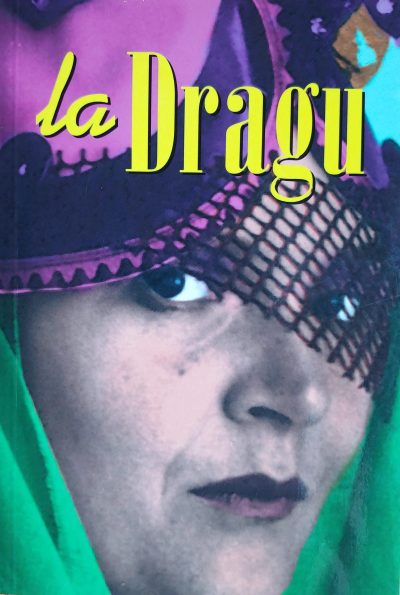
La Dragu: The Living Art of Margaret Dragu 

La Dragu: The Living Art of Margaret Dragu (2002)
Edited by Paul Couillard

Book Design: Randy Gledhill
96 pp. text, 16 pp. photos and DVD insert, 5.5 x 8 inches
Price: $22.50 (plus shipping)

DVD includes the videos Cleaning and Loving It © 2000 and More Cleaning and Loving (It) © 2001, directed by Margaret Dragu and Paul Couillard.

Articles by Glenn Alteen, Paul Couillard, Andy Fabo, Debbie O’Rourke, Sarah Sheard; chronology by Brice Canyon and story and collages by Margaret Dragu.

Margaret Dragu is a 2012 recipient of a Governor General’s Award in Visual and Media Arts. Margaret Dragu is a warm-hearted, fearless and indomitable spirit who has left her mark across disciplines and across the country. Dragu’s astonishing output of work spans back to 1969 and includes forays into theatre, film, video, writing, choreography and above all, performance art. She is perhaps best known for her work in the 1980s, including her long-running X’s and O’s series, which began with a solstice mega-spectacle in Hamilton in 1983 (X’s and O’s on the Longest Day of the Year) and continues with her recent, Improvisation for X’s and O’s. Her 1988 film project I VANT TO BE ALONE reads as a who’s who of the Toronto art scene of the 1980s, while her smaller, more intimate 1990s work has been produced and seen mainly on the west coast. 

To order a copy of this publication, please contact us at info@performanceart.ca

Writing
Remembering Tari Ito

Tari Ito

1951–September 22, 2021

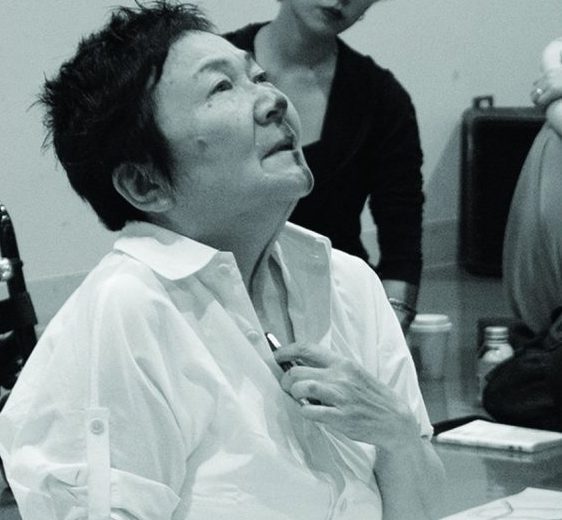
Tari Ito was a Japanese performance artist, organizer, and activist whose work was featured in events across Asia, Europe and North America. She died earlier this year after a ten-year struggle with ALS—an enormous challenge for an artist whose practice was so intensely focused on body movement. She was greatly loved and respected, and many of us mourn her passing. 

I first met Tari in 1990, when she took part in a nine-city Canadian tour of Japanese performance artists, coordinated by Vancouver’s Western Front. She and fellow artist Haruo Higuma spent a week in Toronto, presenting solo works at A Space and also participating in an open “jam” session with local artists. As I recall, it was Pam Patterson and I, working as members of A Space’s performance art committee, who coordinated Tari’s and Haruo’s Toronto appearances. 

For that project, Tari was performing a work she called Memory of the Epidermis, which involved painting large panels of latex “skin” onto the gallery’s floor in advance of her performance. For the Toronto version, she had to improvise using skin she had already created when she could not find the right kind of rubber latex locally. One of her skin objects was a giant balloon-like rubber sphere, as large as her body, which she ended up pushing, bouncing and rolling around the gallery space before finally corralling it in a corner, all the while speaking to it in Japanese—later she told me her words were something to the effect of “What is this giant blister?” 

The work was visual, aural, and above all kinetic, expressing complex relationships and feelings primarily through movement. The rhythm and texture of the performance was varied, ranging from slow, careful gestures to repetitive, staccato motions, always seemingly in reaction to the elasticity of the latex, which could appear either durable or fragile depending on how it was handled. It did not matter that most of us could not understand what Tari was saying in Japanese as she worked with giant sphere: her tone and intonation, and above all her physical interaction with the wobbly figure, were deeply expressive. This visual and gestural communication was also evident in the performance jam, where several of us worked simultaneously without speaking, sometimes side-by-side, sometimes infiltrating or adding to each other’s actions and visuals, creating a striking series of images that I still remember, some of them as accomplished and polished as a finished performance work. It was a charmed encounter. 

The next time I saw Tari was a year later, when she invited me to Japan to take part in the Tajima Performance Festival, co-organized by Yoshimichi Takei and Kyo Hoshino through the auspices of a private group called Scorpio Project. This was the second (and final) iteration of the festival, which took place at the site of the abandoned Yaso copper mine in Japan’s Fukushima district. Billed as a performance art “camp,” the festival was a unique event that brought together performance artists, noise artists, video artists, and Butoh dancers for a week in the countryside, all of us bunking together on the floors of an old wooden schoolhouse. A group of volunteers prepared three meals a day for the participants, who numbered well over a hundred, and performances were self-scheduled using a large blackboard. Each day, artists who wished to perform would write down the time and place (e.g., the quarry, the dam, the schoolhouse grounds, the school gymnasium) of their project, and all of those not caught up in their own preparations or performances would form an audience. Events began each day right after breakfast and continued late into the evening. 

One of the events that Tari organized during the Tajima event was a discussion featuring Clive Robertson, who was then the National Spokesperson for the now-defunct ANNPAC/RACA (Association of National Non-Profit Artist-run Centres/Regroupement D’artistes des Centres Alternatifs). Tari had been deeply impressed by the Canadian artist-run network she discovered on her Canadian tour, and she was hoping that hearing about Canada’s artist network might inspire her Japanese colleagues to band together to create something similar in Japan. Much to Tari’s disappointment, the reception to this discussion was somewhat tepid. Rather than embracing the Canadian example as a possible model for artist-driven organizing, the response of those attending seemed to be that Japan should develop its own ways of organizing rather than looking elsewhere for inspiration. This did not deter Tari’s vision of a supportive artist network, however. Over the years she contributed to a number of feminist art groups, first as part of a collective called afa (Asian Feminist Art), and later founding WAN, the Women’s Art Network, followed by PA/F Space (Performance/Feminist Space). 

Despite her soft-spoken demeanour, Tari had a strident spirit of generosity. Not only did she introduce me to many local artists and even help me find other performance opportunities during my three-month stay in Japan; she also invited all of the Canadian artists who were at the Tajima festival to visit her home in Tokyo, where she lived with her parents. This kind of intimacy was unusual in Japan, where the usual protocol was to meet foreigners at a restaurant. The day of the dinner, there was a torrential downpour, and I arrived at her house completely soaked. She was insistent on putting me in her father’s pyjamas (the only clothes in the house loose enough to fit me) while she washed and dried my clothes. I was embarrassed, but grateful for her kindness. 

If Tari’s connection to Canada proved inspirational for her, it is also important to acknowledge that her presence also played a catalytic role in the development of Toronto’s performance art infrastructure. Tari returned to Toronto in 1993 when she was invited to participate in the Mayworks Festival of Working People by then-director Pat Jeffries, whom Tari had met on her earlier Canadian tour. After Mayworks, Tari stayed in Toronto to explore a romantic relationship with Pat, and she also developed friendships with a number of local artists. When it became apparent that Tari would be in Toronto for an extended period of time, Sandy McFadden, who knew Tari from her time living and working in Japan, suggested to me that we should organize an event for Tari. Here was an internationally known Japanese artist, living in our midst, and Toronto should have more of a chance to discover her work. 

This became the impetus for starting FADO. Sandy, Pam, Ed Johnson, Bernice Kaye and I met in my bedroom one summer day and formed an ad hoc collective to plan our first event, a presentation of Tari’s work. Through my involvement with A Space, which had set aside funds that it would hand out to groups organizing art events as part of its community outreach efforts, I was able to secure enough money to pay for the production costs and a modest artist fee for Tari. Tari wanted to do her performance in a large warehouse space at 1400 Dupont Street, which she had become familiar with from visiting the studio of visual artist Aiko Suzuki. Aiko facilitated a meeting with the building manager, and we were able to convince him to allow us to use the large, unfinished central hall—a huge space, 20 by 50 metres—for Tari’s performance. 

At the time, we had no idea of the trajectory FADO would take, how it would eventually transform into a funded artist-run centre for performance art, or how another FADO event initiated by Sandy, an international performance art festival at CinceCycle in 1996 co-sponsored by Le Lieu in Quebec, would inspire the development of the 7a*11d International Festival of Performance Art. Still, this first project, taking advantage of Tari’s presence in Toronto, already laid the groundwork for what would become FADO’s signature production strategy: an ambitious, site-specific event, cobbled together on a shoestring as an act of faith and community-building. Had it not been for Tari, there likely never would have been a FADO. I am profoundly grateful for the auspicious beginning she provided. 

For her Dupont Street performance, Tari created a new work in her Memory of the Epidermis series, called FACE. One section of the performance featured a row of latex smocks hanging from the ceiling at intervals across the length of the space. Tari followed this line, stepping up to each one and draping it onto her torso until she was covered in a thick layering of skins. Another section featured a very large hanging sheet of latex, 4 by 10 metres, that she punctured and penetrated with her arms. Part of the genesis of these images, she told me, was an unlikely Toronto sight that had captured her imagination. She was intrigued by the telephone poles she saw on the street, covered with staples from guerrilla postering. She found these textured layerings fascinating and beautiful, and was struck by the way they gave evidence of a history of piercing, covering, and removal. For her, they were evocative of the rubber skins she created in her work, which carried with them the inverse outlines of the surfaces they had been painted onto. A video recording of both the preparatory process of creating the skins and parts of the live performance uploaded to YouTube is linked to Tari’s artist page on the FADO website. 

Soon after the FACE performance, Tari returned to Japan when her relationship with Pat ended. I wondered what it would be like for Tari returning to Japan, where being a lesbian—or even identifying as a feminist—could be an isolating experience. Tari’s response was to become much more overtly political and activist. In 1996, she “came out” publicly in a performance work called Self-portrait, which was eventually presented in 26 different venues, including Toronto, where she was part of the Rencontre festival organized by Sandy McFadden for FADO at CineCyle. For Tari, this work signalled a profound shift in her understanding of her art practice, which she realized could be used to convey powerful personal and social messages. Alongside her performances and visual art projects, Tari also began to actively develop and promote feminist and lesbian events, networks, and spaces that spanned beyond Japan’s borders to other Asian countries including Korea and Thailand. 

The last direct involvement I had with Tari’s work was in 2002, when Rochelle Holt curated an exhibition of her work at A Space. The opening night performance, Where is the Fear?, was co-sponsored by the 7a*11d International Festival of Performance Art. Where is the Fear? was an openly lesbian performance with elements of audience participation that Tari developed in part as a response to homophobic remarks by then Tokyo Governor Ishihara Shintaro. Tari presented this work in various Japanese venues as well as Toronto, noting in her book Move, “Sexual minorities live in fear of prejudice. Fear lies in the hearts of people who feel frightened of the idea that there are many different kinds of people in the world” (p. 109). 

Tari made several other visits to Canada over the course of her career, including an appearance at Montreal’s Viva! Art Action Festival in 2006 where she presented Rubber Tit. That performance featured a 2.5 metre-tall inflated rubber tit, which I like to think of as the logical progression of Tari’s “blister” from her early A Space performance. One of her final performances—after a four-year break from performing—was at the LIVE Biennale in Vancouver in October 2019, where she presented Before the 37 Trillion Pieces Get to Sleep, a work that Tari developed in response to the Fukushima nuclear disaster. For this work, curated by Makiko Hara for LIVE, Tari appeared in a wheelchair, and was then laid on large pieces of paper while assistants repeatedly traced the outline of her figure. Tari said of this performance, “The body losing its muscles nonetheless continues to live on. For this reason, I want to stay close to the memories of ‘my body and others’ that were forced into silence or forced to be silent.” A moving description of the performance by Katherine Chan, along with photo documentation by Alisha Weng, can be found on LIVE’s website

I had hoped to bring Tari to Toronto as part of the same tour, to present her work in the context of the KinesTHESES series. Tari wanted very much to return to Toronto, but her deteriorating health made including an additional venue impossible. I suggested that we could perhaps find a way for her to develop the performance remotely, using local bodies to stand in for hers, but such an approach did not fit her vision of the project. She understood her own disabled body to be a key element of the work. She told me that if her body had not been so profoundly compromised, working remotely might have offered an interesting challenge, but precisely because, as she wrote in her hesitant but poetic English, “I stare at the body that is stuck,” she felt it was essential for her to work with her own body, doing only what her own skin, bones, and muscles could accomplish in direct relationship with an audience. The closest the project could get to Toronto was when Pam Patterson’s WIA Projects featured a video installation of the work at Gallery 1313’s Window Box Gallery in early 2020, just as the world was beginning to grapple with the coronavirus pandemic. 

I was sad not to have had an opportunity to work with Tari again, but I rejoice in her ongoing legacy—her performances, which moved audiences on several continents; her organizing and networking efforts, which brought together many artists over several decades; her championing of women’s and minority voices; and, of course, her surprising role in Toronto’s performance art development. And so, I would like to share with you Tari’s humble words from Move’s “afterword,” which seem to me very reflective of her spirit: 

“I believe that the joy of performance art comes from wondering what makes a particular artist engage in a certain action with all of their heart and soul. For this reason, it is actually when I am sitting within the audience of a performance art piece—rather than onstage—that I am the happiest” (p. 185). 

Surely, she shared this happiness with others through her own life and career. 

Paul Couillard, October 2021 

Writing Blue

Writing Blue is the smell of interpretation. Composed of materials that many "know", blueberry candy offers a flicker of nostalgia. Grounded in blue cypress like a hunch that comes from speculation, it is the lavender that offers overwhelming explanations.

Top Notes

blueberry candy

Middle Notes

lavender, mens shaving cream

Base Notes

hyacinth, blue cypress


Deprecated: trim(): Passing null to parameter #1 ($string) of type string is deprecated in /home1/birdskil/public_html/fadodev/wp-content/plugins/simple-lightbox/includes/class.utilities.php on line 545