Performance
-AND- (2021)

12 hour on-line performance event
Curated and organized by Christof Migone

In partnership with and in the context of -AND- (2021), FADO is pleased to present the work of Erika DeFreitas and Adrian Piper in Hour 1.

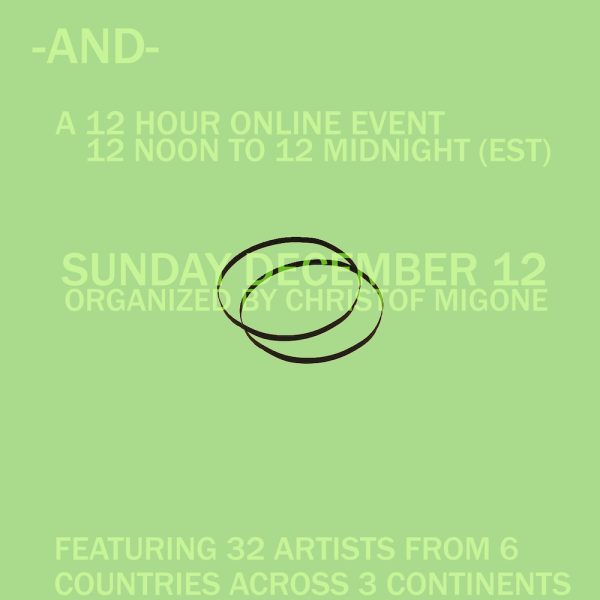
-AND- (2021) is a 12 hour online event organized by Christof Migone. It’s the second in a series of twelve annual events taking place on December 12, from noon to midnight EST with the collaboration of multiple artists, venues and partners in Canada, China, Germany, Korea, UK, USA. Each year the event moves through each word of the 12 word phrase, “you and I are water earth fire air of life and death and activates the word of the year in myriad ways.” For more information about this 12 year project, visit https://youandiarewaterearthfireairoflifeanddeath.com/

In 2021, the word is ‘and’, consequently the focus is on repetitions, conjunctions, and duos. Last year it started with ‘you’, this year we connect you to anything and everything, you are together-with. Or, we get stuck in the very act that ‘and’ opens up, into the enormity that the so-what-next that ‘and’ implies. ‘And’ is all possibilities in a nutshell. A secular litany that follows pi into infinity.

Erika DeFreitas’s (Toronto) multidisciplinary practice includes performance, photography, video, installation, textiles, drawing and writing. Placing emphasis on gesture, process, the body, documentation and paranormal phenomena, DeFreitas mines concepts of loss, post-memory, legacy and objecthood.

Adrian Piper (b. 1948, USA/Germany) is a first-generation Conceptual artist and analytic philosopher. She began exhibiting her artwork internationally at the age of twenty, and graduated from the School of Visual Arts in 1969. While continuing to produce and exhibit her artwork, she received a B.A. in Philosophy with a minor in Medieval and Renaissance Musicology from the City College of New York in 1974 and a Ph.D. in Philosophy from Harvard University in 1981. Adrian Piper produces artwork in a variety of traditional and nontraditional media, including photo-text collage, drawing on pre- printed paper, video installation, site-specific sculptural installation, digital imagery, performance and sound works.

Hour 1
12:00pm–1:00pm EST

Seriation #2a: _and (with thoughts of Adrian Piper) (2021)
In this newly commissioned work, DeFreitas creates a score based on Piper’s essay Passing for White, Passing for Black by isolating the word ‘and’ on the pages they appear. DeFreitas then performs this score, reciting the word ‘and’ evenly spaced within the timeframe of 1 minute per page.

Seriation #2: Now (1968)
Soundwork by Adrian Piper; Performed by Erika DeFreitas
DeFreitas was given permission by Piper to perform Seriation #2: Now. The original soundwork consists in 18 minutes of Piper uttering the word “now,” in a measured tone, at shorter and shorter intervals, from one minute to every second. Accompanying the audio are visuals created by DeFreitas to question our presence in the ‘now’.

Performance
Re-Solutions by W. A. Davison

RE-SOLUTIONS is a collection of 6 performances for video by W. A. Davison, created in the context of FADO Performance Art Centre’s Performance Resolution(s) at-home residency in 2021.

These six informal performance experiments re-interpret the theme “resolutions” as “re-solutions,” meaning, new solutions to problems that have already been solved.

Over the past few years, I’ve been engaged in a number of creative projects that involve exploring, and making use of, material from my archive of past work—finished pieces, documentation, sketches, ideas, etc., accumulated over several decades of artistic activity. The idea of finding new solutions to problems I’ve already solved, i.e. finding new ways to approach, develop, and execute creative problems and premises from my past, is an intriguing concept and ties in nicely with my recent archive-based work.

Working alone in my studio, I conducted a series of performance experiments which were documented on digital video. In these experiments, I examined a selection of finished works from my archive—visual art, writing, film and video, audio, past performances, etc.—determining the basic premise/problem in each one, and then, through an informal, organic, and intuitive process, found new ways in which those problems might be solved. Since the residency is focused on performance practice, these “re-solutions” took the form of performative actions/events/situations. I was particularly interested in what happens when I attempt to translate ideas from other media (drawings, collages, films, audio pieces, etc.) into performance. This was challenging at times but, almost without fail, led to interesting work. The project was process-oriented so I was not necessarily looking to create new performances for an audience. These are, literally, experiments, most geared toward helping me gain insight into my past work, as well as find new and interesting directions for future work. 

Is a work of art ever “finished” or an idea used up? “Re-Solutions” helps answer that question.

THE RE-SOLUTIONS

Dead Horse Dérive (07:10, video slideshow, 2021) is based on a multimedia drawing/painting from 2009 called Wasteland 2. I took one of the main elements of the painting, a dead horse, and traced the contours of it. I then superimposed this simplified contour drawing over a map of downtown Toronto. Finally, on the afternoon of July 10, 2021, I made a dérive (a type of psychogeographic exploration of the urban environment) on bicycle, following as closely as possible the route indicated by the drawing on the altered map. I documented the dérive by photographing streets, intersections, laneways, and whatever caught my eye during the bicycle trip. The final form of the piece is a video slideshow. 

Floating Orb (08:09, video performance, 2021) is based on an untitled collage from 2016. The collage features a spherical object floating in front of a desert landscape. For my “re-solution” I came up with a simple action involving a ball being tossed (from off camera) in front of a number of photographs that were taped to the wall of my studio.

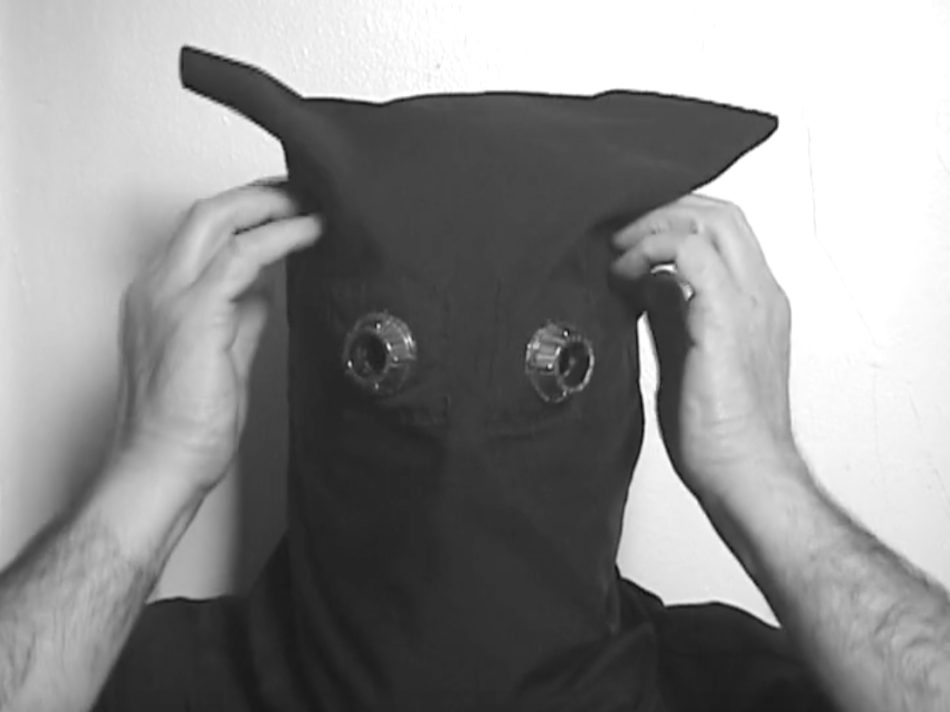
Eye Projections (01:34, video performance, 2021) is based on an untitled sculptural assemblage from 2016. For this “re-solution” I took one of the main features of the assemblage, namely the cloth projecting from the doll’s eye sockets, and interpreted that as a performative action for the camera

Red Branches (02:01, video performance, 2021) is based on a series of sound/radio art pieces from 2020 called RE/CYCLING. In the RE/CYCLING series, I constructed a number of textured platters that were placed on a record player and amplified with a contact microphone. My “re-solution” was to make myself the revolving, textured surface, brushing against amplified tree branches.

R.P.M. Redux (01:23, video performance, 2021) is based on a super-8 film called R.P.M. that I made in 1991, in which I put a super-8 camera on a record player, and filmed while it spun around. For this “re-solution” I did exactly the same thing, this time with a video camcorder, the difference being my presence in the film/performance. I sat next to the record player and appear once every revolution.

Object Poems (11:25, video performance, 2021) is not based on a specific work. Instead, I chose to base the work on one of the techniques I use frequently in my poetic writing, namely stream-of-consciousness or surrealist automatism. The technique involves an unedited flow of words, free from rational control. In my “re-solution” I substituted found objects from around my studio for words in a poem, constructing an improvised, visual poem by juxtaposing objects next to each other or otherwise interacting with them.

Writing
Arborite Housedress Script

Prologue

This is about a domestic love-affair between myself and advanced interior decorating technique. This is about the in-between of my placement, of my desire. Me, in-between: wallpaper valances, contrasting trim, kitchen islands, ferns.

This is about me, trying to make the look work; me, wanting it to all hang together; me, giving it that je ne sais pas; and me, getting the details right, the little things, the finishing touches.

Oh, oh and that feels so…hard.
Oh, oh, oh, and I’m so very…pointed.
Oh and yes and oh…I think I’ll… clean up a bit.

Introduction

I am so clean! I am so white! I’m so up, pro, up, pro, up on life!
‘Cause I’ve got a contract, a done deal, signed (clap), sealed delivered
And I’m his.
I’ve been chosen for the whitest, brightest smile.
I’ve been saved, because sin won’t stick to me.
I’ve been taken and it’s about time, too.
I’ve got this contract,
This marriage contract, signed (clap) to him in the big white robe,
Signed (clap) over to his slightly crucified but still attractive son,
And signed (clap) again on earth with ink on paper making me third-hand goods,
A-signed (clap) to a man in the flesh who mows the lawn.

There are so many things that I know, because he says so.
And he should know because he makes them happen.
The weather, that’s him.
American foreign policy, that’s him, too.
Natural disasters, prime-time programming, he does it all
His way.
A real self-starter, a self man-made
In his own image:
The weather, American foreign policy, natural disasters, prime-time programming,
And me.
Not bad, eh?
Not too shabby.
Kinda scary!
I mean, I wouldn’t want to get on his bad side, no.
Because the dark side of good is really bad.
I know, because I’m so good.
I’m so clean! I’m so white! I’m so up, pro, up, pro, up on life!

Marriage

Marriage is a lot like driving a car. Let’s say you’re going on a little trip, just the two of you. You pack your bags, jump in, and go. Now, how many of you are sitting behind the steering wheel? How many of you are actually doing the driving? That’s right, only one of you. There’s only room for one person in the driver’s seat. And what does he do? He controls the direction and speed of the vehicle. He indicates which way he’ll be turning and he toots the horn. In short he carefully maneuvers the car for the good and safety of all of the passengers. But that doesn’t mean that the co-pilot isn’t very important, too. When there’s two people in the car, she reads the map, finds the best radio station, provides pleasant conversation, and passes snacks to the driver. She has a very busy job, but she is not driving. In fact, what would happen if she reached over and grabbed the steering wheel? What would happen if she suddenly decided it was her turn? The car would go out of control, wouldn’t it? Even if she just leaned over to flick on the headlights, even that would startle the driver, and he might get into an accident. This shows us a very important point. When people don’t do what they’re supposed to do, when people don’t stick to their jobs, they end up hurting not only themselves, but others as well. Let’s take a look at Adam and Eve in the garden. When Eve took that apple, who was in the driver’s seat? And where did she end up driving them? You know where. Down a one-way freeway straight out of paradise. Eve took a wrong turn. But her big mistake was taking the wheel in the first place. Not only did it have serious repercussions for her, her family, and the entire course of human history, it also made Adam feel bad. Not only was it an extremely dangerous thing to do, it also hurt Adam’s feelings. And that’s not very nice, is it? It’s not very nice, and it’s not very smart. Because the driver can get in the car alone, and still start it up and make it run. He might get a little lost, he might not get any snacks, but he can still get up and go. Whereas the co-pilot, when she climbs into the car by herself, ends up spending a lot of time in the driveway, just reading those maps.

Bridge

The dark side of good is really bad.
I know, because I am so good, so clean, so white
That every dirty thought shows up bright-
Ly on my immaculate construction.
Every dirty thought can be read like an open book
Spelling what I want and how I want it, when.
Words you see scratched on bathroom walls.
Words you’re embarrassed to know.
Humiliating, needy words
Show up
On my complexion.

Romance Novels

My fantasies exist between the pages of paperback novels published every four days in fourteen languages for an average cost of $4.95…Canadian.
Reading Windswept Summer, Nurses’ Folly, or Indiscretion at Midnight
In Punjabi, Cantonese, or Cree
Is the only reason I can think of for bothering to learn another language.
Those foreigners, the way they speak,
It’s as if they’re always yelling.
But I’m sure that those languages wouldn’t sound so bad
Tripping from the lips of
Clark Cowell, Troubled Millionaire,
Whistled from between the teeth of
Flint Blackwell, Brilliant-But-Lonely Surgeon,
Or whispered by
Jon (that’s J-O-N) Johnson, International Explorer, Oxford-Educated, Hunk-A-Burning-Love, who has a Six-Figure Annuity and has Never Really Loved Before.
I know this is awfully liberal of me to admit
But if Jon Johnson was willing to take me
To his ancestral castle in the south of France,
Make love to me for hours every day,
And ask me what I think from time to time
I wouldn’t mind if he spoke Lebanese, or Zulu, or…French.
I really wouldn’t mind too much.
I wouldn’t mind a bit.

Fantasy #1 – Border Town Romances

Fantasy #1: Border town romances (twirl).
What makes border town romances so…special?
The meeting of culture? The mystery of difference?
The preciousness of each and every moment?
Or is it the pain of longing? The difficulty of talking?
The disapproval of one’s family and friends?
Perhaps it’s that they only exist in the present.
You probably won’t have time to discover each other’s personal habits.
Taking out a mortgage together just isn’t in the cards.
And across that border you have a better chance of being shot, than of getting pregnant.
It makes sex seem less risky.
It makes sex seem more fun.
It makes you feel that the border doesn’t really exist.
Your love is stronger than its walls.
Your love transcends all obstacles.
Your love is absolutely, positively unique.
While it lasts.
Oh, you know it can’t.
It’s impossible. It’s insane. It’s…O.K.
You have an out. An escape hatch. Fine print.
Because forever is really an awfully long time.
Forever takes too long.
And it all becomes the same after awhile:
On and on and on without end.
So, if you’re lucky, it’ll be tragic.
It’ll be epic, yet it’ll be quick.
Your love will be spectacular from start to finish.
And afterwards you can cry and cry, grieve and remember.
You’ll live with your memories
And you have more time to shop for other things.

Bridge

My fears in life are few and far between:
Saturated fat,
Communism,
And GRAVITY.

Sagging Flesh

A woman’s foundations are exceedingly important in an increasingly gravity filled world. This sneaky phenomenon—gravity—this downward pull that threatens my very concept of up and down, replacing it with lower, lower, lower; this force is actively conspiring against us for no other reason than spiteful adherence to some banal law of physics. It’s a bit of a downer, to say the least. As I find my flesh collecting in puddles at my feet, my nipples lolling in hard to find places like corners, under beds, beneath bric-a-brac shelves, constantly getting stuck in the hose of my vacuum cleaner. But the real problem is not the extra housework that these downwardly mobile body parts entail. I hesitate to admit it, but it’s true: my very real concern is that parts of my dangerously sagging self might end up in bad neighbourhoods. And what then? How could I fight? There’s no bleach strong enough to save my shimmering self. I could scrub and scrub and rub and rub, but those streets, those people will never know sparkling, lemon fresh, central vac, and snow white appliances. How could they? Their ways are uncertain and unsafe, not even aware of the dirt under their nails, the bacteria populating their surfaces, their skins dark and shadowy. They may be happy in their ways, but how could I manage among them? Surely no better than they among us.

These are the thoughts that keep me awake nights worrying, that stain my dress with rings of nervous perspiration throughout the day. For it seems not improbable that bits of my body might end up there, on the wrong side of the tracks. And therefore to continue to believe that the line between “me” and “them”, “same” and “Different” is firm and perky would be naive. Especially when the stretches and wrinkles in my skin illustrate how fluid my own borders are. So perhaps it’s alarmist, and perhaps it’s not, but I cannot sit idly by and await this prodigal fate. I must women my defenses and women them well; batten my hatches, and buckle and snap myself into underwear that binds and separates, having painfully evolved from lingerie to veritable architecture.

Bridge

My fears in life are few, it’s true,
But my fantasies can’t be counted.

Fantasy #2 – The List

Fantasy #2: achieving everything on my to-do list (twirl).
As I suck dirt into my waiting bag of empty, clean space
As I fill the interior of my open-plan, decorator-deluxe hollowness
I think of curtain stays,
Grid suspended pot racks,
Self-feeding electrical cords,
And other time-saving restraints.
I can’t get enough of this dirt.
Frankly, it’s just not dirty enough for me.
But I’m trying to make do, trying to make out
Tiny specs that have fallen between my cracks
That I can come to on my hands and knees
And rub and scrub until I slip in the grease of my own elbows.
The dust and the grime of this house are mine
Traces of my body that I massage
With brushes and sprays and an entire array
Of highly toxic germ fighting solutions
To the problem of “a woman’s work never really being done.”
It sounds like a small thing to get excited over — dirt —
But then we are expected to get excited over little things.
And this proof of my untidy, ever-exfoliating self
Tells me I am here
I am real in this world of gloss
The mess I feel is real.
I know it—it is of me—and it knows me
Well.
It knows my flesh.
It knows, and it holds me there,
Bent over sinks,
Arms deep in toilets,
Crawling across floors
Wanting the dirtiness of dirt.
Wanting to take back the dirt.
Take back me.
Take it in.
Suck it in.
Lick it in.
Be in dirt.
Be in me.
Come in me.
Dirtily.

But I want it, I want it, I want it. All. Instead of this scary get-down, show down, between none other, is there anything worse, than saturated communism, and sneaky, pinko fat?

Marriage Quiz

One: Question. What makes marriage so attractive?
Two: Bigger student loans? A good excuse to move out of your parents home? Wedding presents?
One: No. I mean, why did you marry? What led up to your decision to join together in holy union?
Two: It seemed like a good idea at the time.
One: But haven’t there been benefits to being a married woman?
Two: Could you repeat the question?
One: Let’s try another one. When I say, “To have and to hold…,” you think of….
Two: Strangulation? Suffocation? The correlation between ownership and theft?
One: When I say, “‘Till death do us part…,” you feel….
Two: Homicidal? Suicidal? Resistant to the concept of reincarnation?
One: You’re not trying very hard. We’ll try again. Question. What does marriage mean to you?
Two: Infinite compromise. Sacrifice. Selflessness. Losing oneself entirely.
One: That’s better! And who is the most important person to remember in a marriage?
Two: Me! Him? (pause) God? (bells and whistles)

Fantasy #3 – Lesbian Nation

Fantasy #3: lesbian nation (twirl).
Being a domestic goddess isn’t all it’s cracked up to be.
Have you ever noticed that you can wash the floor in the morning, by nightfall it looks just the same as before you started? That you can do all of the dishes, and in a matter of hours someone has gone and dirtied them again? That children are little grime magnets, picking up all manner of stubborn stains and bringing them home again?

Well, I’ve been thinking. If I could get rid of my family, it would effectively cut my work load by 60%. And then I would finally have time to devote myself more fully to being a homemaker. Then I could start to get ahead in the domestic world. Make something of myself. Achieve those far off goals. Perhaps move up to a ranch style. Without PTA or connubial duties getting in the way.

And you know, I bet I’m not the only one. I bet there are hundreds, maybe thousands, maybe even millions of women who would also benefit from the absence of men and children in their lives. As it is now, think of all the wasted human potential. Think of how clean it could be, if we were all freed from the inconvenience of those to whom we are joined by blood and marriage. I, for one, would have more time to devote to the common good. I’d gladly spend a half-hour vacuuming the boulevard, and afternoon dusting a jungle-jim. I, and others like me, would getup our gumption and get out of the home to make the entire world a spic-er, span-er place. There’s no end to what we could acheive together. We could tidy up toxic waste sites! Redecorate urban decay! Sew some shoulder pads into the economy! Why it would be paradise! It would be sparkling! It would be the first lesbian, separatist nation!

Bridge

I’m so clean, I’m so white
I’m so crisp and hard and still and right
That every twitch and tremor I make turns out left or wrong
Proof positive of a strong predisposition toward voluntary hysteria.
I slice my palms on the creases of my dress.
Everything is so well pressed.
It’s a problem area.
I am a problem area.
This is the problem:

Conclusion

I am a domestic alter
Location of discipline, receiver of guilt
My lipstick (kisses palms) glows bloody
The wound in my side a testament
To the persistent pain of splinters
Chaffing me each time I try to move
In this bungalow that never fit
Right?
In the first place
There was Eve
Experiencing for the first time the downward pull
The long fall from grace to graceful A-lines
In no-stick, hi-gloss, easy-to-maintain finishes
To a place where everyone has the same blood-type: clean
And whiteness and Godliness
And might and right
And home and family
All tidily equal up
In a divine floor plan
Three bedrooms, sunken living room, patio off the breakfast nook,
Repeated over and over and over again
Tomorrow is another day
-Ly bread, our kingdom comes
Unlike me
In this straight jacket against desire
Where passion plays on TV
And we only communicate in clichés
Based on stories that only end badly
For me.
Performance
Five Holes: Matters of Taste

ARTISTS
Tejpal S. Ajji
Jess Dobkin
Gyrl Grip
Irene Loughlin

FADO presents four performance environments dealing with the sense of taste in this final ‘gustatotry’ component of the Five Holes series.

Taste is perhaps the most ‘personal’ of all the senses. It is both primal—providing the impulses that drive consumption—and individualized: one person’s desire is another’s poison. While the word ‘taste’ is often associated with the concept of aesthetic discernment, Matters of Taste places its emphasis on a specific, visceral definition of taste: the perception of flavour and texture that takes place inside our mouths.

This series explores the implications of a sense that operates through the placement of foreign material inside one’s body. Matters of Taste is not concerned with the familiar social terrain of banquets and dinner parties so much as the links between physical sensation, unconscious/conscious drives, and our mouths as a point of contact with the external world. How does one orchestrate a performance for another’s mouth? What are the dynamics that seduce, persuade or convince others to put things in their mouths? What are we or aren’t we willing to put in our mouths? What intentions are bound up in the impulse to stimulate one’s taste buds? What does our sense of taste reveal about our internal desires and external projections?

Performance
Five Holes: Listen!

Erika DeFreitas
Linda Rae Dornan
Eric Létourneau
So-Yeon Park
Jed Speare

Curated by Paul Couillard

Five Holes: Listen! presents five unique performance ‘maneuvers’ dealing with the sense of hearing. Five Holes: Listen! is the fourth offering in the multi-year Five Holes series that seeks to examine the nature and importance of bodies (performer and audience) in performance art by focusing on individual senses.

This iteration in the series considers acts of “listening” as they are carried out by and impact upon physical, social, political and spiritual bodies. In OPEN, Linda Rae Dornan presents herself as a solitary figure, sitting quietly in the city, listening—encouraging us to also stop for a moment to hear what we normally ignore. Erika DeFreitas performance, entitled Untitled: Selective Hearing, offers her presence for a one-on-one exercise of listening as a way of locating the self. In A Quiet Zone II, Jed Speare lobbies the city for a quiet zone that would serve as an area of sound awareness. So-Yeon Park assembles chanters from various cultures to direct their voices toward individual participants’ wishes as a way of channeling transformative energy in Interfaith Chanting/Praying Ceremony. And in Standard III, Eric Létourneau evokes silence as a way of marking and remembering all of the world’s victims of political persecution in a multi-layered project that interrogates the role of the State and of mass media in silencing “silence” itself.

OPEN by Linda Rae Dornan
September 15, 2004 @ 8:00am–12:00pm | Queen’s Park, Toronto
September 16, 2004 @ 8:00am–12:00pm | University Avenue traffic island, south of Gerrard Street
Artist Talk September 16, 2004 @ 8:00pm | WARC, 122–401 Richmond Street West

OPEN features Linda Rae Dornan in a durational tableau performance of listening, only listening, in an open space surrounded by non-functioning audio speakers. It is about slowing down, actually hearing the world breathe around oneself, and being part of that breath. Time slows down, and one is absorbed into the soundscape, into hearing oneself and the world.

Untitled: Selective Hearing by Erika DeFreitas
September 25–October 24, 2004
Saturdays & Sundays @ 9:00am–5:00pm | various locations
Presented in conjunction with the 7a*11d International Festival of Performance Art

Untitled: Selective Hearing explores the sense of hearing and more specifically the act of listening as an intimate act of inclusion, trust, and the location and dislocation of self amidst a variety of public venues in Toronto. Artist Erika DeFreitas will be offering her shared presence to those who are interested in taking the time to sit and listen to their surroundings. Participants sign up for a particular place and time to join the artist in a conscious act of listening to the surrounding space. DeFreitas notes about this piece: “Our society depends heavily on conscious auditory perception as being selective, and this perception has created a culture of selective hearing. Our ability to ‘block’ things out allows us to choose when we want to listen, what we listen to, and what we hear. Various components of our surrounding environment have perpetuated this practice of filtering sound and have dictated what is allowed to take root and what must be discarded. Such forms of selective hearing and escapism can alter our environment in a surreal way. In his writing about conceptual art, I believe that an awareness of the ways that a sense of space or environment can be established through sound, as well as an understanding of how we might unconsciously use sound to essentially make an environment transferable, can develop through a process of active listening.”

A Quiet Zone II by Jed Speare 
October 7, 2004
Artist Talk October 7, 2004 @ 4:00pm | Rectory Café, Ward’s Island

In A Quiet Zone II, Jed Speare seeks to establish a zone of quiet through municipal channels in a neighbourhood of Toronto—not for the purpose of restricting noise, but for promoting sound awareness and contemplation. Under city by-laws, Quiet Zones regulating noise activity can be established around hospitals and retirement homes. Speare’s proposal seeks to overturn and expand the notion of the Quiet Zone philosophically and idealistically, creating an occasion and site for an aesthetic experience, listening to a particular urban environment. For the past several months, Speare has been seeking the appropriate agency to initiate a formal process to create a zone in the inner harbour at Ward’s Island. From late September, Speare will be working in Toronto to meet with community members and officials and continue this process, culminating in an event on October 7 that will present his progress to-date, at a site and time to be determined. A Quiet Zone II is supported in part by a residency at Do While Studio in Boston and a grant from the Nicholson Foundation. Download Jed Speare’s Quiet Zone (pdf)

Standard III by Eric Létourneau
Artist Talk October 21, 2004 @ 9:00pm | XPACE, 303 Augusta Avenue, Toronto
Presented with 7a*11d International Festival of Performance Art

Eric Létourneau’s “manoeuvre” Standard III began as a two-hour uninterrupted nationwide radio broadcast on Radio-Canada on April 11, 2004 (Easter). The program featured 198 30-second periods of radio silence punctuated by an alphabetical listing of every country in the world. The same phrase introduced each silence: “Thirty seconds of silence for domestic and foreign political victims…” This broadcast was recorded live off the airwaves and remixed for publication on two CDs along with a text that considers the effects of administrative regulation and State control on mass media. Beginning in October 2004, copies of the publication will be sent through diplomatic channels to each country of the world. On the occasion of each country’s national celebration, its head of state will be contacted to verify the receipt and subsequent response to the CD.

Interfaith Chanting/Praying Ceremony by So-Yeon Park
January 27, 2004 @ 7:00pm
Alumni Hall of Victoria College (University of Toronto), 91 Charles Street, Toronto

Interfaith Chanting/Praying Ceremony is an interactive event organized by Korean artist So-Yeon Park. Park has assembled a circle of local volunteer chanters from a variety of religious traditions who will direct their voices toward participants’ wishes as a way of channeling transformative energy. Audience members are invited to walk around the circle and listen, as well as to enter the circle and hold a wish while the chanters surround them and pray for their wish to come true. Park explains, “This spontaneous multi-faith circle of chanting and prayer brings together people from many faiths. Religious/spiritual practitioners are invited to experience and share their own deep faith in an environment of diverse spiritual devotion. Viewers will have an opportunity to witness and feel the power of prayer.”

Performance
Five Holes: reminiSCENT

reminiSCENT, curated by Jim Drobnick and Paul Couillard, is the third installment in FADO’s ongoing performance series, Five Holes, which examines the significance of the body and the senses. 

If the sense of smell appears to have been eclipsed by the other senses in Western culture, there is one realm in which it retains an almost mythic stature—memory. reminiSCENT acknowledges the powerful relationship between smell and memory, and explores the artistic and cultural potential of this undervalued sense. Documentation in literature and science indicates that no other sense evokes memory as intensely as smell. For Marcel Proust, a whiff of madeleine conjured up the world of childhood; for Helen Keller, smell was a “potent wizard” that transported one across thousands of miles. Even newborns, after just a few days, recognize and remember their mothers via the distinctiveness of smell. As compelling as these olfactory experiences are, there is a tendency to regard smells purely on the level of immediacy.

Yet fragrances also bear complex social meanings. How, what and why we smell are subject to many cultural influences – one only has to consider hygiene, and the myriad ways in which the body is bathed, cared for and scented, to appreciate the way smell plays a role in embodying and transmitting culture. In short, smell is as much a learned, cultural practice as it is a physical act of perception.

The five projects in reminiSCENT focus on both of these aspects of scent, as a practice and a physical act. Smell and memory can interact in diverse ways, especially when memory is considered via its multiple dimensions: personal, cultural, social and historical. How, for instance, do odours affect the self and the narrative of one’s life? How can scents symbolize or mark political moments and historical eras? In what ways are aromas significant to the creation of cultural memories and identity? How do power and status play out on an olfactory level? Such questions are implicitly raised in the performative installations of reminiSCENT.

Through faux marketing campaigns, quasi-scientific experiments, intimate encounters, unrehearsed rendezvous, and indecent appropriations of public space, these artists engage with the spectrum of smell from the everyday to the abject. Using organic substances, synthesized scents, perfumes, ambient odours, fragrant language and aromatized bodies, these projects foreground the diverse potential of smells in discourse, experience and culture. Visitors may feel their olfactory abilities being tested and their preconceptions about the sense of smell challenged as the role of scent is foregrounded in the contexts of race, tourism, perfume, domesticity and sexuality.

While the main premise of reminiSCENT concerns the role of scent in memory, there is also a more general imperative to recollect the sense of smell itself and its place in culture as a whole. The progressive deodorization of homes, buildings and public spaces since the nineteenth century has created what one geographer calls “blandscapes,” contemporary places that are sensorially numb and devoid of perceptual interest. The artworks of reminiSCENT symbolically and viscerally reconnect visitors with the smell of natural processes and material existence. Even with the rampant commercialization of olfaction in the past decade, evidenced by the profusion of commodities imbued with scents and the appropriation of aromatherapy for air fresheners, it is important to remember that smell has a meaningfulness outside of corporate marketing and brand-name identity. Smell is often declared the oldest of the senses, and this curatorial project rediscovers its capacity for art, knowledge and social significance.

ABOUT THE PROJECTS

Pull Up To The Bumper, by Clara Ursitti, occurs in a white stretch limousine, the acme of celebrity display and mobile partying. For selected performance-goers and chance passers-by, an intimate conversation and olfactory experience awaits as they cruise the streets of Toronto. The limo’s sensuous, private interior, complete with refreshments and other luxury comforts, is a chamber redolent with the spirit of seduction. In this gender reversal, a woman holds the balance of wealth, status and sexual agency as the artist inquires into the dynamics of stardom and urban prowling.

On The Scent by Helen Paris and Leslie Hill, in collaboration with Lois Weaver, reconfigures an apartment with olfactory performances and interventions. Visitors journey through a series of visceral encounters that infuse the residence with heightened experiential potential. A trail of scents leads to stories and confessions wafting unexpectedly through the space and secreted away in compartments and corners. Reflecting upon the significance of smell in everyday life, this aromatized environment intensifies the role scent plays in identity, emotion, place and memory. Each performance lasts 30 minutes and is performed for 2 audience members. Please reserve your spot, there are a maximum of 40 participant spots in total.

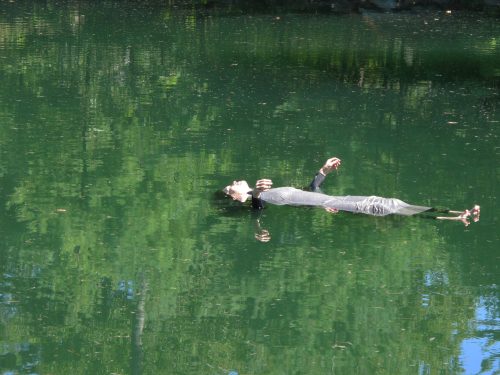
Cheli Nighttraveller’s untitled performance addresses racism operating at the level of the body and hygiene. Since the era of first contact, the so-called “odour of the other” has served as a pernicious means by which European colonizers stigmatized First Nations peoples. Reflecting at the edge of a fountain in Berczy Park, Nighttraveller recalls an episode in the life of Quannah Parker, the last chief of the Comanches, who once caused a stir by bathing in a public fountain. The artist will satirically confront the misconceived but persistent fiction of “cultural stench.”

Inspired by the legendary exoticism and adventure of The Seven Seas, Millie Chen and Evelyn Von Michalofski provide an occasion for virtual travel with The Seven Scents. Cruise ship deck chair recliners face the waters of Lake Ontario and invite bystanders to lie back, relax, listen to a series of soundscapes and inhale the ambiance of distant locales. Like spa therapists, the artists will gently facilitate each lounger’s sensorial reverie. Distilling together sound and scent, romance and reality, the piece evocatively contemplates the fantasies of escape and the economic actualities of tourism.

Shawna Dempsey and Lorri Millan’s Scentbar promises unique, personalized scents scientifically tailored to each client’s memories, anxieties and desires. Trained technicians will tally the answers to visitors’ scent-questionnaires and concoct custom-made perfumes in their laboratory cum parfumerie. Drawing from a top-secret odour palette, their potions transcend the use of scent for fashion or flirtation. These one-of-a-kind distillations connect the wearer intimately and olfactively to the complexities of the contemporary world – they are fragrances for troubled times

SCHEDULE & LOCATIONS

Pull Up To The Bumper by Clara Ursitti
Street intervention: September 18, no set times
Exhibition and limo tour: September 20 @ 6:00-9:00pm
Karen Schreiber Gallery, 302-25 Morrow Avenue, Toronto

On The Scent by Helen Paris & Leslie Hill (with guest artist Lois Weaver)
September 19–21, please register to experience this performance
168 Simcoe Street, Toronto

Untitled by Cheli Nighttraveller
September 20 @ 12:00pm
Berczy Park, Front Street, Toronto

The Seven Scents by Millie Chen & Evelyn Von Michalofski
September 20–21 @ 12:00pm–4:00pm
Harbourfront Centre, 235 Queens Quay West, Toronto

Scentbar by Shawna Dempsey & Lorri Millan
September 20 @ 6:00pmKaren Schreiber Gallery, 302-25 Morrow Avenue, Toronto

A Reading with Deanna Ferguson and Judy Radul

The A Space Events Committee in cooperation with FADO is pleased to sponsor a poetry reading by Vancouver artists Deanna Ferguson and Judy Radul, who are currently on tour to promote their new books. 

Poetry reading and book tour with Deanna Ferguson and Judy Radul

Paul Couillard, 1994

Deanna Ferguson’s collection of poems The Relative Minor was recently published by Tsunami Editions of Vancouver. Her work has also been published in absinthe, Front, hole, Jag, Raddle Moon, Writing, West Coast Line and the anthology East of Main (Pulp Press). Ferguson’s poems are a collage of fragmented images and familiar phrases, peopled with pop icons from Jack Kerouac and Sid Vicious to Spock and Elvis. The effect is a distillation of the violent and the mundane framed in an unsettling shorthand.

Judy Radul is an interdisciplinary artists who has worked with the spoken and written word, performance, installation, photography, video and film. She has published three books including Character Weakness rivulets cross cross cross vision (1993), Boner 9190 and the weak (1989), both by KNUST press in Holland, and Rotating Bodies (1988) by Peterad Press in vancouver. She was recently the editor of Front magazine published by the Western Front in Vancouver, and is currently the curator Front Gallery. 

Judy Radul’s writings follow visceral experiences to unexpected conclusions. She probes the soft underbelly of first-person experience, finding the degradation, humiliation and occasionally exultation in being. Character Weakness rivulets cross cross cross vision is a limited edition hand-made artist’s book printed in full colour using a special process involving old and new Gestetner printing processes.

Paul Couillard, 1994

Death, Sex, & Macrame (and other works) with David Bateman

This Performance Club WORKSHOP will consider several of David Bateman’s past performance works, and ways in which he has re-considered various narratives/performance texts around sex and gender over the past thirty years. Works to be looked at may include: Death, Sex, & Macrame (2019), I Wanted To Be Bisexual But My Father Wouldn’t Let Me (1992), and Art Immuno Deficiency Syndrome, subtitle; Does This Giacometti Make Me Look Fat? (2016).

Expect reading, writing and macrame curtain weaving.

Save your Thursdays this September for the ultimate trio of Queer Performance Clubs performed by Moe Angelos (September 10), Hope Thompson (September 12) and David Bateman (September 14 & 19).

WORKSHOP: Death, Sex, & Macrame with David Bateman
September 14, 2019 @ 2:00pm–5:00pm
The Commons @ 401 | 401 Richmond Street West, 4th floor, Toronto

Artist
Hope Thompson

USA / Sweden

https://www.mccoble.com/

Embracing unpredictability, messiness and failure MC Coble has worked with performance art for over 20 years, through this time aiming to manifest problems of bodily, societal and symbolic navigation particularly focusing on issues of injustice and normative boundaries. Recurrent themes in Coble’s work revolve around queer politics evolve around the intersection of queer politics and activism.

Coble’s work, which has been included in exhibitions such as Queer Objectivity at The Stamp Gallery, University of Maryland (Baltimore, USA); The Great Refusal: Taking on New Queer Aesthetics at theSchool of the Art Institute of Chicago (Chicago, USA); Lost and Found: Queerying the Archive at the Nikolaj Center of Contemporary Art (Copenhagen, Denmark); and in the internationally traveling archive re.act.feminism #2–a performing archive.

Coble has performed live as part of 13 Festivalen, Festival of Performance Art (Gothenburg, Sweden), Rapid Pulse Performance Festival (Chicago, USA), MADE Festival (Umea, Sweden); in Commitment Issues presented by FADO Performance Art Centre (Toronto, Canada), Global Feminisms, Brooklyn Museum of Art (NY, USA) and in Performa 05 at Artists Space (NYC, USA).

Coble is a Senior Lecturer in the Fine Art Unit, MFA Programs at Valand Academy of Art, Gothenburg University, Sweden.

Performance
9Questions, an artist project by Gustaf Broms

Lorem ipsum dolor sit amet, consectetur adipiscing elit, sed do eiusmod tempor incididunt ut labore et dolore magna aliqua. Ut enim ad minim veniam, quis nostrud exercitation ullamco laboris nisi ut aliquip ex ea commodo consequat. Duis aute irure dolor in reprehenderit in voluptate velit esse cillum dolore eu fugiat nulla pariatur. Excepteur sint occaecat cupidatat non proident, sunt in culpa qui officia deserunt mollit anim id est laborum.

Performance
The Talking Grave by Hope Thompson

Lorem ipsum dolor sit amet, consectetur adipiscing elit, sed do eiusmod tempor incididunt ut labore et dolore magna aliqua. Ut enim ad minim veniam, quis nostrud exercitation ullamco laboris nisi ut aliquip ex ea commodo consequat. Duis aute irure dolor in reprehenderit in voluptate velit esse cillum dolore eu fugiat nulla pariatur. Excepteur sint occaecat cupidatat non proident, sunt in culpa qui officia deserunt mollit anim id est laborum.

Performance
Queer/Play

Lorem ipsum dolor sit amet, consectetur adipiscing elit, sed do eiusmod tempor incididunt ut labore et dolore magna aliqua. Ut enim ad minim veniam, quis nostrud exercitation ullamco laboris nisi ut aliquip ex ea commodo consequat. Duis aute irure dolor in reprehenderit in voluptate velit esse cillum dolore eu fugiat nulla pariatur. Excepteur sint occaecat cupidatat non proident, sunt in culpa qui officia deserunt mollit anim id est laborum.

Performance
Art Immuno Deficiency Syndrome, subtitle; Does This Giacometti Make Me Look Fat? by David Bateman

Lorem ipsum dolor sit amet, consectetur adipiscing elit, sed do eiusmod tempor incididunt ut labore et dolore magna aliqua. Ut enim ad minim veniam, quis nostrud exercitation ullamco laboris nisi ut aliquip ex ea commodo consequat. Duis aute irure dolor in reprehenderit in voluptate velit esse cillum dolore eu fugiat nulla pariatur. Excepteur sint occaecat cupidatat non proident, sunt in culpa qui officia deserunt mollit anim id est laborum.

Performance
Valley of the Dolls by Keith Cole

Lorem ipsum dolor sit amet, consectetur adipiscing elit, sed do eiusmod tempor incididunt ut labore et dolore magna aliqua. Ut enim ad minim veniam, quis nostrud exercitation ullamco laboris nisi ut aliquip ex ea commodo consequat. Duis aute irure dolor in reprehenderit in voluptate velit esse cillum dolore eu fugiat nulla pariatur. Excepteur sint occaecat cupidatat non proident, sunt in culpa qui officia deserunt mollit anim id est laborum.

Performance
Book Club: snowflakes in the echo chamber by Moe Angelos

Lorem ipsum dolor sit amet, consectetur adipiscing elit, sed do eiusmod tempor incididunt ut labore et dolore magna aliqua. Ut enim ad minim veniam, quis nostrud exercitation ullamco laboris nisi ut aliquip ex ea commodo consequat. Duis aute irure dolor in reprehenderit in voluptate velit esse cillum dolore eu fugiat nulla pariatur. Excepteur sint occaecat cupidatat non proident, sunt in culpa qui officia deserunt mollit anim id est laborum.

Series
Public Spaces / Private Places

Public Spaces / Private Places was a three-year long international performance art series featuring 22 projects, created by 26 artists, from Canada, the US, Europe and Asia. The series explored the elements that turn neutral ‘space’ into meaningful ‘place’ through performances that examined the degrees of intimacy, connection and interaction that mark the dividing line between public and private. The series was particularly focused on performances created for intimate audiences. Some projects featured site-specific or installational environments that invited participants into a sensory or experiential journey. Others were process-oriented, involving public intervention, intimate gestures, or actions that were, by their nature, nearly invisible. Above all, the series explored the points where identity and geography intersect to generate meaning.

The series took place in Toronto in various locations, from 2000–2003, and was curated by Paul Couillard.

Series
TIME TIME TIME

TIME TIME TIME was a 12-month series of durational performance art works by artists from the UK, US and Canada, presented in Toronto and curated by Paul Couillard. TIME TIME TIME presented works ranging from 12 hours to several days. Ritual, endurance, attention span, community-building, altering states of consciousness, boundaries between public and private, narrative, linearity and transformation were explored in the series by artists presenting their compelling, urgent visions of ourselves and our world at the end of the 20th Century.

January: Linda Montano
February: Alastair MacLennan
March: Rebecca Belmore
April: Tanya Mars
June: Roddy Hunter
June: Shannon Cochrane
August: Frank Moore
September: Otiose (Ailith Roberts and John Dummett)
October: Jennifer Nelson and Glen Redpath
November: Jenny Strauss
December: Clive Robertson
December: Paul Couillard

Curatorial Statement by Paul Couillard

‘Performance art’ is a difficult beast. Not many people really know the term, and even less could say what it means. For those ‘in the know’, the definitions vary widely: some definitions are very personal, while others are tied to very precise and limited historical references.

My own approach to understanding or defining the term ‘performance art’ is ‘radical’—in the sense of looking to the ‘roots’ of the practices grouped under the term ‘performance’. Performance has four basic formal elements: time, space, the body of the performer(s), and the relationship between performer and audience. In broad terms, performance includes the various established forms of ‘theatre’ (in all its genres from recitation to puppetry to melodrama and so forth); ‘dance’ (from ballet to tap to ballroom); and ‘music’ (classical, a cappella, rap…). I use the term ‘performance art’ to name works that engage the four elements of performance, but use one or more of them in ways that are unfamiliar, unexpected, or initially unrecognizable within the cultural context that they are presented.

For the past 15 years, I have been creating and producing works that I call performance art. In calling them performance art, I am suggesting that the ‘project’ of these works, or at least of my involvement with them, has been to explore the basic elements of performance, to experiment, to research—often, to push at what appear to be the established boundaries of form. To create new forms. To look at forms outside of my personal cultural currency. To be consciously a misfit.

The premise of TIME TIME TIME is to look at the element of time or duration through performance art.

We have very odd ways of understanding time. This is apparent in how we mark time in units that can seem relatively ‘objective’ (‘days’ and ‘years’, determined by the earth’s relationship to the sun—and useful for things like planting crops or knowing when it will be dark or light) or ‘subjective’ (e.g. ‘the millennium’), depending on what we know or imagine about how these measurements came to be. Is a second meant to be a heartbeat? Why are there 60 of them in a minute? Why 24 hours in a day? Why 12 months in a year?
Here in North America at the end of the 20th Century, the measurement of time seems to press heavily upon us. Our attention spans have been perhaps sharpened but undoubtedly shortened by technologies of our own creation, while an artificial row of zeroes may be poised to wreak havoc on the electronic infrastructures of what we call ‘civilization’ and possibly on our collective psyches as well. It seems an appropriate time to look at ‘time’, to return to our ‘roots’ in time.
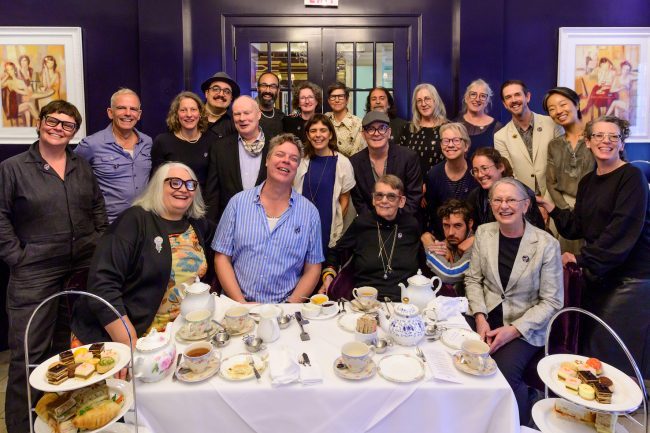
TIME TIME TIME is a series of 12 works by different artists, presented in Toronto over the course of a year (1999)—approximately one a month—with each work lasting a minimum of 12 continuous hours.

Twelve continuous hours is one full sweep of the face of a clock, a commonly understood time marker that surely holds many conscious and unconscious cultural connotations. Half the length of a day, twelve hours is generally long enough to encompass at least one transition of light—from ‘day’ to ‘night’ or vice versa. It is longer than the average work period, but within the realm of many types of shift work. Twelve hours is certainly a far longer time period than that normally associated with either spectatorship or entertainment, but not an unheard-of length of time for engagement in a task, or for many forms of teaching, community activity, or spiritual practice.

Twelve hours is also a long enough period to raise several practical bodily considerations for the artist in terms of going to the bathroom, drinking, eating and sleeping. Artistry is, in many ways, a response to restrictions; it is the agency that one carves out of the confrontations and resistances one encounters in the struggle to create or express. With but a single formal restriction (that the piece must be a minimum of 12 continuous hours in length), TIME TIME TIME offers the audience a chance to look at how 12 sets of artists solve these ‘practical’ problems that time brings about. How do these artists turn 12 or more hours into a performance? How do they invite an audience to engage with this work? And what clues does this provide to us about how these artists understand what performance is, what time is, and how meaning is produced through time?

This sampling of work is in no way meant to be taken as a definitive survey of the durational performance work being produced right now. Although I attempted to bring together a range of artists and approaches, the curatorial process was limited by both financial restrictions and my own ignorance. Every day I learn of other artists and works that I would have liked to have seen included here. Nevertheless, I am extremely proud of the calibre of work in this series—by artists from several cultural backgrounds, of varying ages, and at various stages of their careers. They are teaching me a great deal about the mysteries of time. It is a rare privilege to be able to observe and participate so closely in the process of these generous, creative souls—and I am forever transformed by their work.

Series
Canadian Performance Art Legends

Since 2000, FADO has been celebrating Canada’s senior performance artists with this multi-faceted series. Featured artists are asked to create a major new work, which is followed by a (text and video) publication documenting the artist’s history in performance. The series curator and publication editor is Paul Couillard.

Canadian Performance Art Legends has honoured:

2000
Margaret Dragu
Cleaning and Loving It (performance, 2000)
La Dragu: The Living Art of Margaret Dragu (publication, 2002)

2004
Tanya Mars
Tyranny of Bliss (performance, 2004)
From Ironic to Iconic: The Performance Work of Tanya Mars (publication, 2009)

2006
Alain-Martin Richard
The Route to Rosa (performance, 2006)
Alain-Martin Richard: Performances, Manoeuvres and Other Hypotheses for Disappearing (publication, 2014)

Series
Performance Club

2017–2019

As a proposition for a performance or the framework for an actual book club, FADO’s Performance Club series redefines the historical and contemporary performance art canon, one book club, and one book/article/essay/anthology at a time. Invited artists perform the role of book club facilitators, leading the audience through a performance of a reading, a reading performance, a performance about a book, or a bookish performance. This series is on-going. Sometimes we pick the book and invite an artist; sometimes we invite an artist and they pick a book. Just like a real book club, we ask the audience to read the suggested material before coming to the performance. But don’t worry, just like a real book club, no one ever does. 

Performance Club 1: Queer/Play
Edited by Moynan King
Performance by Moe Angelos
December 14–15, 2017

Performance Club 2: Valley of the Dolls
Performed by Keith Cole
January 20–February 20, 2018

Performance Club 3: 9Questions, an artist project by Gustaf Broms
The time we made our own book (2018).

Performance Club 4: Book Club: snowflakes in the echo chamber
Performed by Moe Angelos
September 10, 2019

Performance Club 5: The Talking Grave
Performed by Hope Thompson
September 12, 2019

Performance Club 6: Art Immuno Deficiency Syndrome, subtitle; Does This Giacometti Make Me Look Fat?
Performed by David Bateman
September 19, 2019

Series
MONOMYTHS

Conceived and curated by Jess Dobkin and Shannon Cochrane

MONOMYTHS invites a diverse collection of artists, scholars, and activists to revise Joseph Campbell’s conception of the hero’s journey through performance art, lectures, workshops, and other offerings. This new assemblage of non-linear un-narratives proposes a cultural, political and social feminist re-visioning of the world. The MONOMYTHS perception of the universal journey dispels the notion of the lone patriarchal figure on a conquest to vanquish his demons–both inner and outer–in consideration of community, collectivity, and collaboration.

Joseph Campbell’s influential book, The Hero with a Thousand Faces (1949) prescribes a common pattern to all of the world’s mythic narratives. According to this fundamental structure, the archetypal hero is challenged to embark on a monumental quest. Over the course of the hero’s journey, trials and obstacles must be overcome until a victory is won and the hero returns home with new knowledge about himself and the world. Campbell’s concept of the monomyth (‘one myth’) is a recognizable motif in both ancient mythology and contemporary culture, including film, music, literature, sports, and advertising. A current trend in popular visual culture replaces the male character with a female one, in spite of the fact that our heroine–from the get-go–would make different choices if the conditions, and conditioning, allowed. While each MONOMYTHS stage stands alone, the work of each presenting artist is interdependent and connected. These independent visions, when stitched together through the audience’s collective presence, form an exquisite corpse of a larger experimental narrative.

The year-long MONOMYTHS project is presented in three sections starting in February 2016 and concluding in February 2017.

Part 1 (February 3–7, 2016)
Stage 1: The Ordinary World/Call to Adventure
Stage 2: Refusal of the Call
Stage 3: Meeting of the Mentor
Stage 4: Crossing the Threshold
Stage 5: Belly of the Whale

Part 2 (May 2016–January 2017)
Stage 6: Tests, Allies, Enemies
Stage 7: Ordeals
Stage 8: Atonement with the Father/State
Stage 9: Apotheosis/Journey to the Inmost Cave

Part 3 (February 15–19, 2017)
Stage 10: The Road Back
Stage 11: Refusal of the Return
Stage 12: Mistress of Two Worlds
Stage 13: Freedom to Live
Stage 14: The Return Home

Series
IDea

Curatorial Statement by Paul Couillard

Issues of identity are at the centre of IDea, FADO’s multi-year international performance art series. Chris Barker writes that cultural politics are about “the power to name; the power to represent common sense; the power to create ‘official versions’; and the power to represent the legitimate social world.” These powers speak to identity in a territorial, institutionalized framework, but performance practices offer the possibility of turning their presumed weaknesses—contingency, ephemerality and aterritoriality—into strengths, by offering a potentially decolonized, non-institutional forum.

The concept of identity has been at the forefront of art discourse since the 1980s. Performance artists have been particularly concerned with how our various identities are constructed, how they mark us and how they influence self-understanding. At the same time, artists have also used performance tactics to problematize and transform their identities. In recent years, the debate has shifted to examine identity issues in subtler, less didactic ways, using the territory of identity as a ground for complex and often ambivalent readings of subjectivity, hybridity and representation. IDea draws from this growing body of work.

The series considers a broad range of identity labels, including gender, skin colour, ethnic origin, religion, sexual orientation, physical appearance, familial role, economic status, political affiliation and profession, to name a few of the more obvious possibilities. In blunt terms, the series will circulate around an underlying set of interrelated questions. How do we accept or resist these multiple identities? Which do we choose to embrace, and why? What identity labels are misleading, unhelpful or irrelevant, and in what ways? How do these labels intersect with one another? How do they determine the nature and quality of our lives? How do they contribute to a sense of belonging or alienation?

While these questions inform the series, they are only a contextualizing lens, not a prescription for how individual projects should or will be structured. IDea is not about representation, or the politics of difference, which is to say that the intention is not to assemble a collection that presents one of each kind. We are not encouraging strident political statements (though there is certainly room for them), but rather, featuring works that reveal something about how the creators understand and situate themselves. Along the way, we also hope to track how artists use performance tactics to circumvent prescribed attitudes and behaviours around identity.

IDea seeks to consider a range of bodily identities—physical, social, political, emotional, and spiritual. To provide further context for the series, commissioned critical that respond to each of the performances. These texts will come from an interdisciplinary variety of thinkers in the realms of philosophy, religion, politics and science.

The IDea series presented 12 performance projects between 2005–2007, and was curated by Paul Couillard.

Series
Escapist Action: Performance in Recession

Escapist Action: Performance in Recession
Curatorial Statement by Don Simmons

Daily media reports bombard us with the reality of the current worldwide economic situation. We are in the midst of a recession. Businesses are failing and offering discount prices on everything in the store, the stock market is volatile, companies are looking for bailouts, and government agencies are giving away bloated stimulation packages.

Despite these tough economic times, some businesses are experiencing a boom. Alcohol sales are up; Hollywood movies are experiencing a surge in attendance and theatres are reporting a rise in audience numbers. People need to escape from their problems and forget about reality. During tough economic times, art relating to escapism prospers.

Escapism is an immersive art. It satisfies a desire for sensual pleasure. It envelops the viewer in a hermetic and narcissistic space where reality is suspended. Stimulated by an individual’s need for escape the realm of the imaginary is opened and new possibilities arise. Non-places that do not exist make themselves possible, submerging the individual and leaving them in a state of confusion. Spectators who participate or view an escapist action become disconnected from their everyday surroundings and transport themselves to a place of contemplation or simply blank out. 

Escapist Action: Performance in Recession begins with a weeklong series of performance events that investigate economics and presents the audiences with alternative methods of exchange. The series culminates in three evening programs of performance entitled Black Friday, Red Flag Saturday, and Grey Cup Sunday. These three evening investigate the mixed emotions evoked by the volatile economic market. The performances navigate the sensations of fear, despair, laughter, and hope. The audience is transported from the dark emotions of Black Friday through the humour of Red Flag Saturday arriving at the celebratory Grey Cup Sunday.

Julian Higuerey Núñez and Ignacio Pérez Pérez activate Escapist Action by creating an alternative barter system in which performances and time can be exchanged between the artists and audience. The exchange starts with an Open Barter Market on Monday, November 23, followed by a 72-hour performance (6 days / 12 hours each day). Tomas Jonsson’s work creates a redundant economy across the street from a storefront display he mimics. In the piece Magpie, Jonsson observes the shopkeepers display, purchases items from the shop, and then sets up shop across the street. Jonsson consciously contradicts traditional exchange structures by giving away items, available for purchase at the neighbouring store, to passersby who engage the artist in conversation. Joanne Bristol presents an intimate service based performance dealing with internalized space as a form of escapism in her performance entitled Association for Imaginary Architecture.

The first evening program takes place on Black Friday. Renowned as the biggest shopping day in the US, and an indicator for financial forecast for the upcoming holiday season, Black Friday also refers to the financial crisis of 1869. On Black Friday, Julian Higuerey Núñez and Ignacio Pérez Pérez start the evening with the last performance of their twelve-hour day. Claude Wittmann explores the fears we experience in times of economic uncertainty and the mob like tendency to blame it on the “other”. In this case Wittmann looks at the instances in history where woman have been labeled as witches and damned for financial hardship within communities. Rodolphe-Yves Lapointe addresses risk taking and responsibility in a final desperate act of escapism.

Black Friday is followed by Red Flag Saturday. The Red Flag signifies warning, defiance, left-wing politics and amazing sales at department stores. This evening’s tone is decidedly lighter than Black Friday, compelling the audience to escape from their recessionary blues and find some relief in humour. This evening begins, like Black Friday, with a portion of The Artist and the Beanstalk by Julian Higuerey Núñez and Ignacio Pérez Pérez. Then John G. Boehme explores adolescent escapism and Joanne Bristol encourages Torontonians to relocate to the “wallet friendly” city of Winnipeg. 

Escapist Action: Performance in Recession concludes with Grey Cup Sunday, a performance party in celebration of escaping the daily grind with cheap televised entertainment and the excitement of an annual national sporting event. David Frankovich’s Grey Cup Party mixes high and low brow activities, morphing the football party with an Earl Grey tea party to reveal hidden sexual truths.

Series
Emerging Artists

Initiated in 2003 by Tanya Mars, FADO’s Emerging Artists Series was created to provide an on-going professional venue for emerging artists from Toronto and beyond to develop and present a performance piece, working within a curatorial framework set out by an emerging curator. FADO’s intention with this series is to nurture new work and ideas, provide direction and mentorship to both the artists and the curator, and to showcase the work of the city’s newest perspectives in performance art.

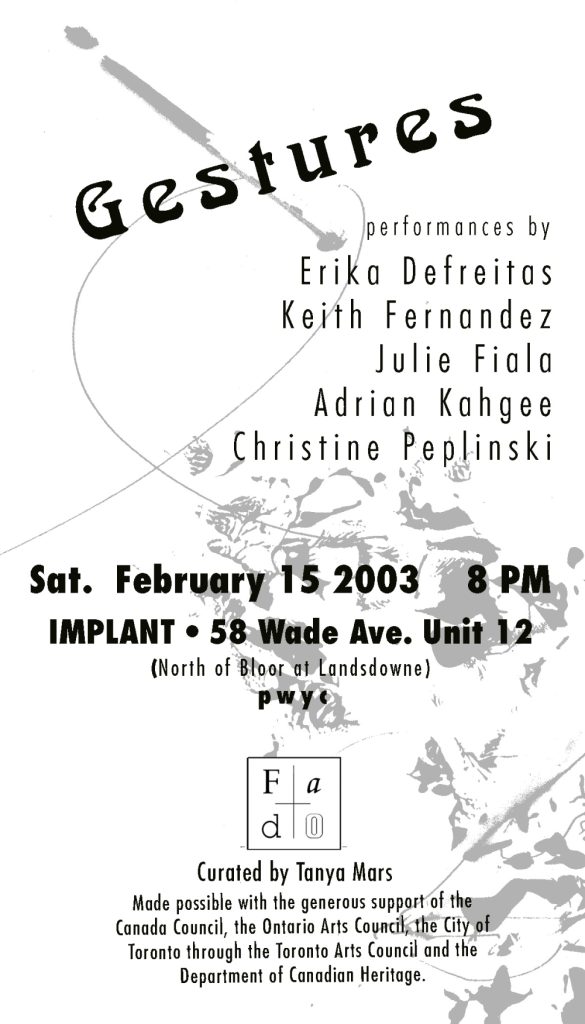
FADO’s Emerging Artists series was initiated in 2002 by Toronto-based artist and educator Tanya Mars, who recognized that the best way to encourage young artists was by offering them a professional exhibition opportunity. Her vision was one of mentorship, targeting an interesting mix of new and emerging artists, many of them former students, whom she commissioned to develop new works responding to a thematic context. The initial evening of ambient, conceptual and cabaret-style performance art gestures curated by Mars later developed into a series designed to highlighting the work of Toronto-based emerging performance artists.

As the series developed, it became clear that this was an opportunity to nurture not only emerging performance artists, but also emerging curators. This strategy allows FADO to encourage new curatorial voices in performance art—an urgent need—and introduces us to new communities of artists. Most recently, the series has further developed to include artists not just from Toronto, but regionally as well. This furthers the series goal to showcase the range of work happening in the emerging performance scene in Canada.

The Emerging Artists series was a staple of FADO’s programming year from 2003 to 2014, and was always one of the most popular events in our performance art calendar.

2003: Gestures | curated by Tanya Mars
2004: Game City | curated by Craig Leonard
2005: Feats, might | curated by Alissa Firth-Eagland
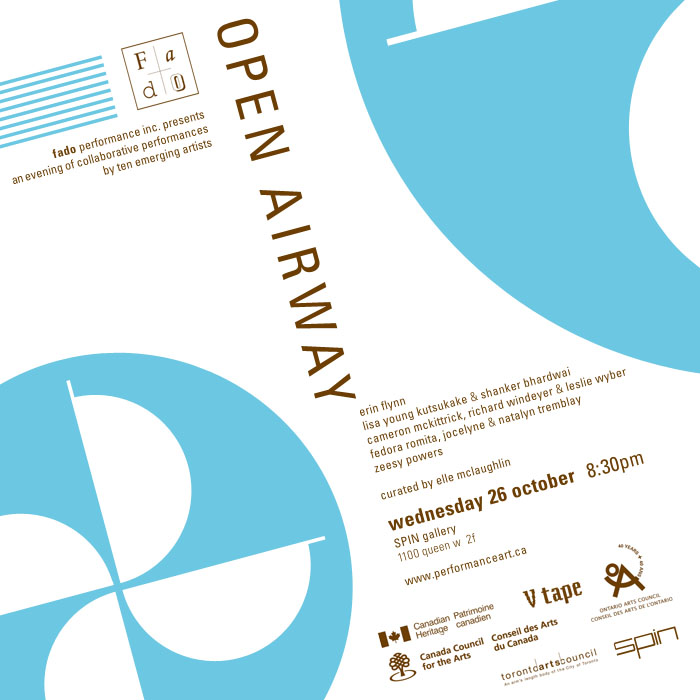
2005: Open Airway | curated by Elle McLaughlin
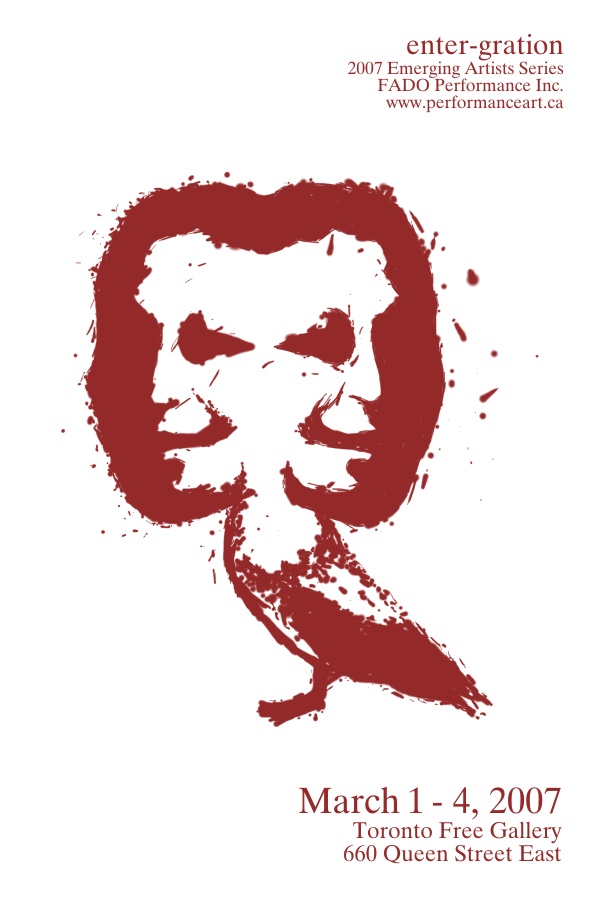
2007: Enter-gration | curated by Nahed Mansour
2008: Vivência Poética | curated by Erika DeFreitas
2009: Misinformed Informants | curated by Lisa Visser
2011: Extra-Rational | curated by Gale Allen
2013: .sight specific. | curated by Francisco-Fernando Granados
2014: 11:45 P.M. | curated by Kate Barry

Performance
Conjuring the Archive by Jess Dobkin

A Performance conversation with Jess Dobkin

September 18, 2019 @ 7:30 pm
The Commons @ 401, 401 Richmond Street West
FREE / Accessible space & washrooms

In 2018–2019, Jess Dobkin received a Chalmers Art Fellowship in support of her current on-going research project looking at the performance art archive—her own personal archive and the archives of notable organizations and artists in the USA, UK, Mexico, Hong Kong and Canada.

Jess Dobkin approaches the archive as both site and material to investigate the lifespan and spirit life of performance art. Building on her ongoing research in international performance archives, she interrogates the relationship between live performance and documentation to explore the dynamic ways that performance can exist before and beyond the live event.

Her performance will invite the audience to create a DEMPSEY AND MILLAN TALIXMXN, an energetic archive of the performances and projects of Shawna Dempsy and Lorri Millan. On July 22, 2019 a fire destroyed a warehouse in Winnipeg that housed the studios of more than two dozen artists. Shawna and Lorri lost 30 years of artwork, costumes, ephemera, books, equipment and materials. This TALIXMXN is an honouring of Shawna and Lorri’s archive and an offering of archival magic.

Performance
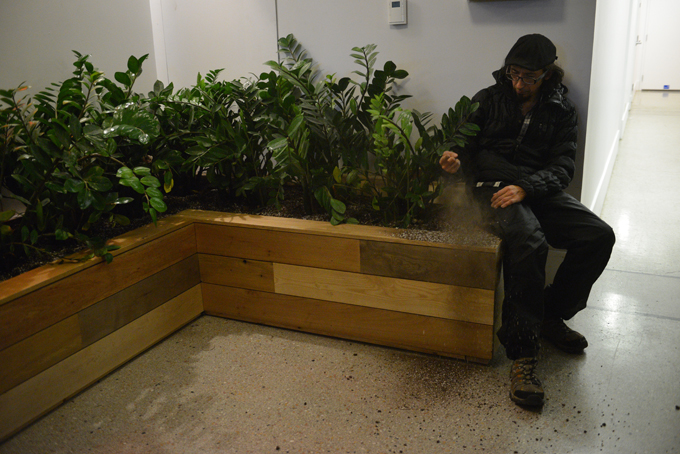
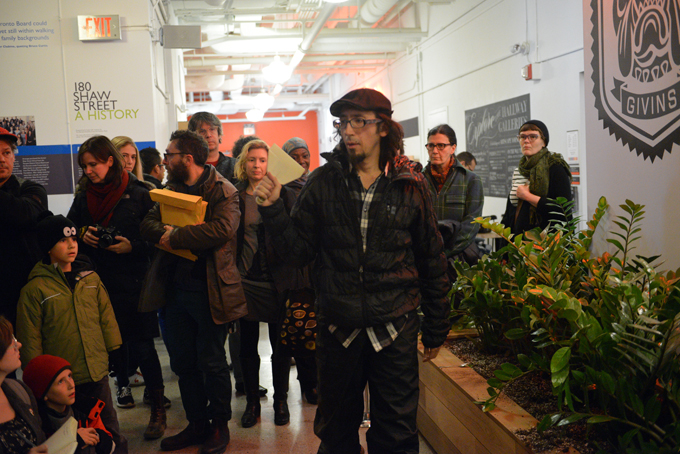
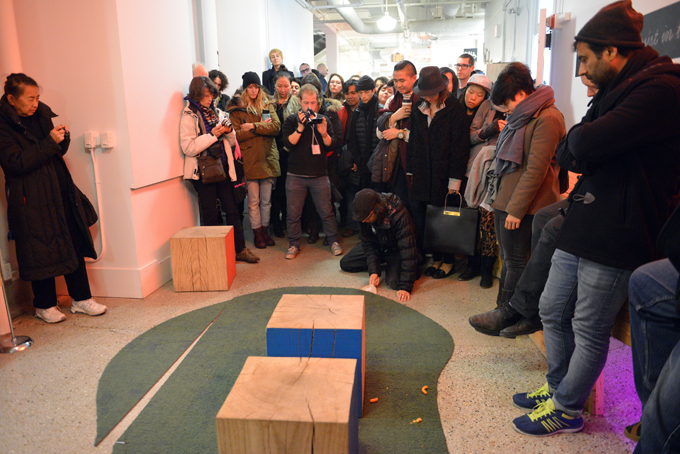
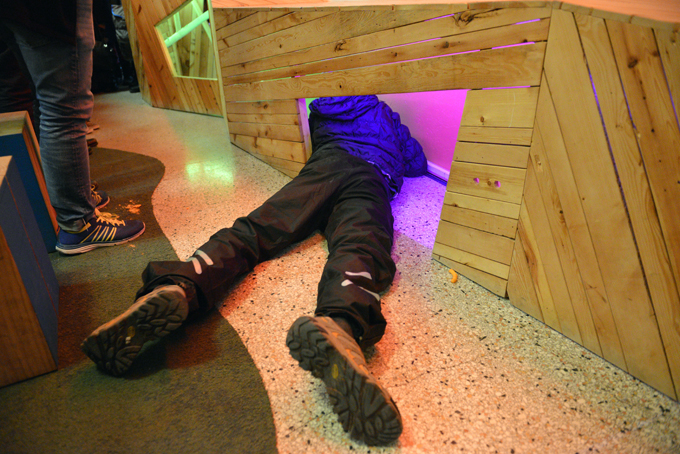
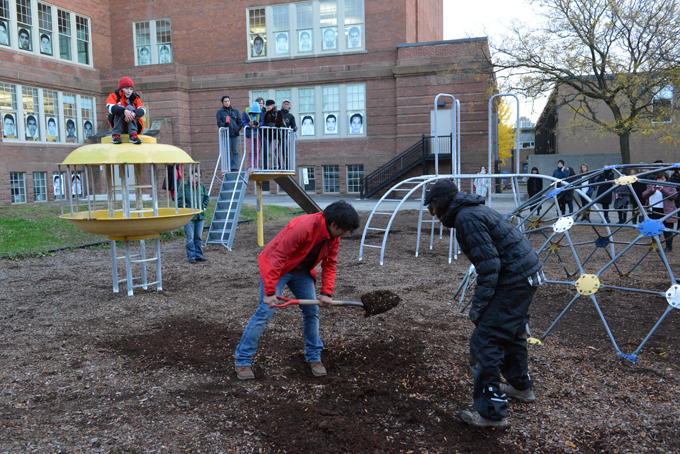
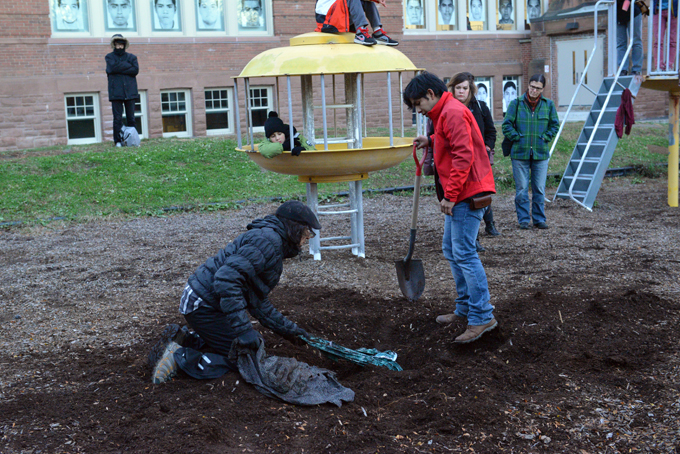
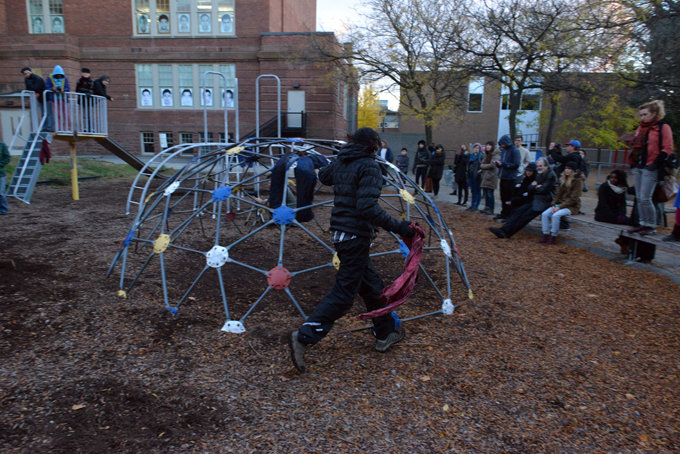
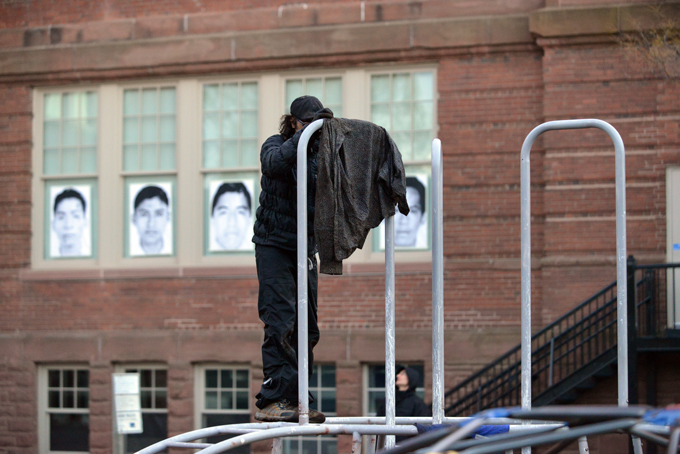
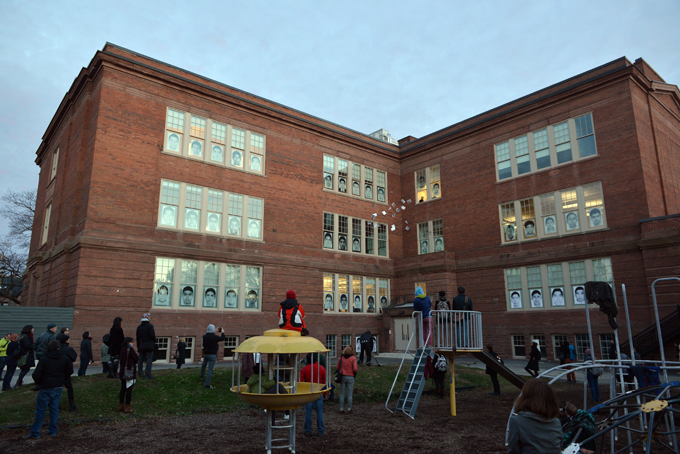
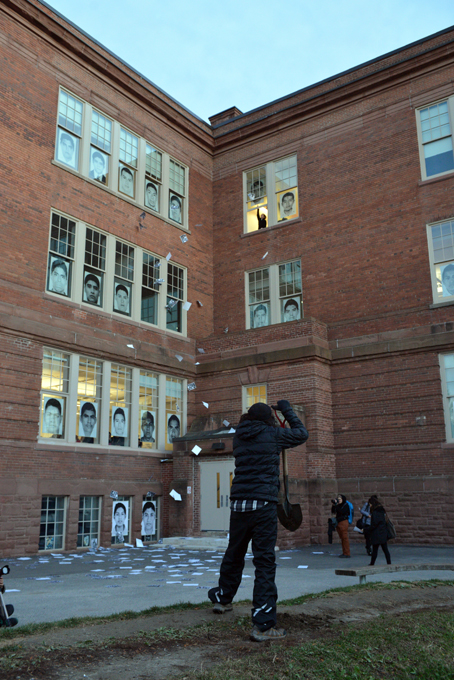
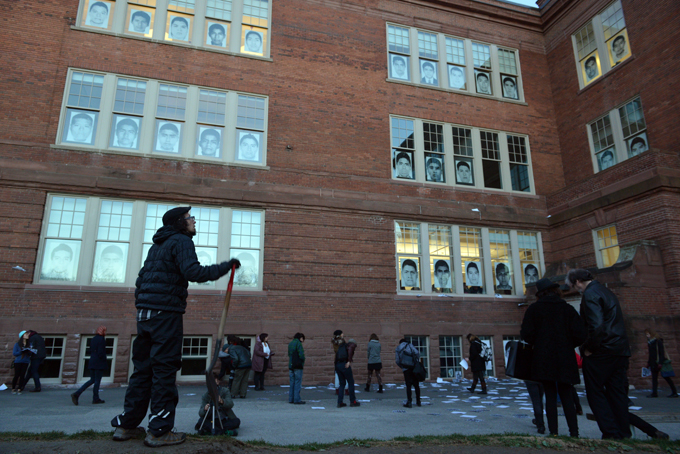
AYOTZINAPA, busqueda, muerte y renacimiento by Roberto de la Torre

Presented by FADO Performance Art Centre in the context of the 7a*11d International Festival of Performance Art.

Roberto de la Torre works with temporary and contingent elements, and his work is usually generated in the public sphere. Manifesting as ephemeral actions in the form of sculpture, architectural, and sensory experiences created through the use of different media, and often employing the collaboration of a large number of participants, de la Torre’s work is best understood as documentation of the transient. The focus of his work ranges from social issues that occur in the local context as well as a global context. A tension between the physical and the intellectual permeates the fabric of his work, and the notion of “social sculpture” is developed through complex negotiations of permissions and participation in each setting the work takes place.

Ayotzinapa, muerte y renacimiento
Ayotzinapa, death and revival

Performance:
November 2, 2014 @ 4:00pm
Artscape Youngplace, 180 Shaw Street, Toronto

Performance Art Dailies (artist panel):
October 29, 2019 @ 1:00pm
Artscape Youngplace, 180 Shaw Street, Toronto
Border Crossings with Roberto de la Torre, Ali Al-Fatawi, Wathiw Al-Ameri, Serena Lee

7a*11d International Festival of Performance Art
October 29–November 2, 2014
www.7a-11d.ca

Performance
I was there by Francesca Fini

Presented by FADO Performance Art Centre in the context of the 7a*11d International Festival of Performance Art.

I was there, because I’m here now. I was there, even before being and idea in my mother’s head.

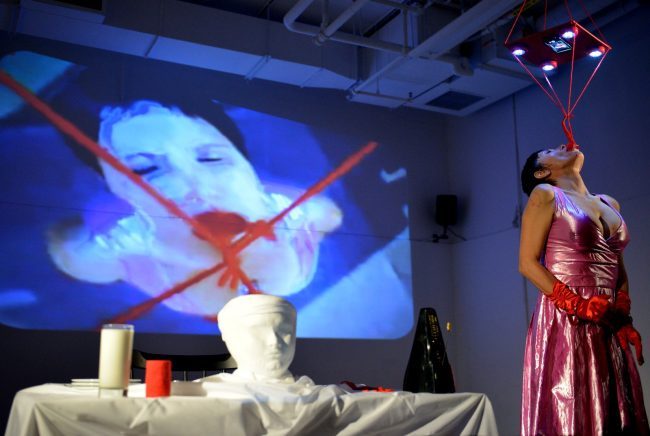
I was there is a live art project where the traditional languages of documentary and “mockumentary” are subverted and updated, while blending with the surrealism of live media performance. In the performance the artist approaches the past of western civilization – and the one of my her own family – by digitally and lively inserting herself into historical pictures and movies. Fini sabotages the past in a metaphysical scenario that integrates live media, video projections and chroma key technology, and ends up loosing herself while becoming “part of the picture”. It’s an impossible encounter with the past, with culture, and with family, in which space and time collapse into the ideal dimension of performance art.

Thanks to the Istituto Italiano di Cultura in Toronto.

Performance:
November 1, 2014 @ 8:00pm
Artscape Youngplace, 180 Shaw Street, Toronto

Performance Art Dailies (artist panel):
November 1, 2014 @ 1:00pm
Artscape Youngplace, 180 Shaw Street, Toronto
Uncomfortable Physicalities with Francesca Fini, Eduardo Oramas, Andrée Weschler

7a*11d International Festival of Performance Art
October 29–November 2, 2014
www.7a-11d.ca

Performance
Arborite Housedress by Shawna Dempsey & Lorri Millan


Music Gallery

179 Richmond Street West, Toronto

Co-sponsored by A Space and the Music Gallery

In Arborite Housedress, the pro/antagonist defends herself against racial and economic difference by clothing herself in the domestic architecture of the times: the house/dress is her shimmering, clean fortress and her prison. Throughout the piece she reveals her fears (such as gravity, or the fear that “parts of my dangerously sagging self might end up in bad neighbourhoods”) and her fantasies (border town romances, getting down with dirt, and the elimination of her family, so she will have time to devote herself more fully to being a homemaker). The wearable sculpture/costume has been exhibited at many art galleries and has been purchased by The Winnipeg Art Gallery as part of their permanent collection.

“Have you ever noticed that if you wash the floor in the morning, by nightfall it looks just the same as before you started? That you can do all of the dishes, and in a matter of hours someone has gone and dirtied them again? That children are little grime magnets, picking up all manner of stubborn stains and bringing them home again? Well, I’ve been thinking. If I could get rid of my family, it would effectively cut my work load by 60%.”

Arborite Housedress is one performance from The Dress Series (1989–1996), a group of performances that explore the dress as the female ceremonial costume and icon of femininity.  In these pieces, cloth is replaced by unlikely materials, creating juxtaposition, new meanings and upending expectations. All costumes fabricated by Dempsey and Millan.

For more information on this performance and the series, visit Dempsey and Millan’s website.

Artist
MC Coble

USA / Sweden

https://www.mccoble.com/

Embracing unpredictability, messiness and failure MC Coble has worked with performance art for over 20 years, through this time aiming to manifest problems of bodily, societal and symbolic navigation particularly focusing on issues of injustice and normative boundaries. Recurrent themes in Coble’s work revolve around queer politics evolve around the intersection of queer politics and activism.

Coble’s work, which has been included in exhibitions such as Queer Objectivity at The Stamp Gallery, University of Maryland (Baltimore, USA); The Great Refusal: Taking on New Queer Aesthetics at theSchool of the Art Institute of Chicago (Chicago, USA); Lost and Found: Queerying the Archive at the Nikolaj Center of Contemporary Art (Copenhagen, Denmark); and in the internationally traveling archive re.act.feminism #2–a performing archive.

Coble has performed live as part of 13 Festivalen, Festival of Performance Art (Gothenburg, Sweden), Rapid Pulse Performance Festival (Chicago, USA), MADE Festival (Umea, Sweden); in Commitment Issues presented by FADO Performance Art Centre (Toronto, Canada), Global Feminisms, Brooklyn Museum of Art (NY, USA) and in Performa 05 at Artists Space (NYC, USA).

Coble is a Senior Lecturer in the Fine Art Unit, MFA Programs at Valand Academy of Art, Gothenburg University, Sweden.

Artist Talk with Anna Banana

Anna Banana is a Canadian artist from Vancouver known for her performance art, writing, and work as a small press publisher. She has been described as an “entrepreneur and critic”, and pioneered the artistamp, a postage-stamp-sized medium. She has been prominent in the mail art movement since the early 1970s, acting as a bridge between the movement’s early history and its second generation. As a publisher, Banana launched Vile magazine and the “Banana Rag” newsletter; the latter became Artistamp News in 1996.

In this artist talk presented by FADO Performance Art Centre at A Space, Anna Banana talks about her work in performance, and her various mail art projects including ARTISTAMP News and BANANAPOST.

Performance
FACE (Memory of the Epidermis) by Tari Ito

Co-presented by A Space and supported by The Japan Foundation.

When life comes to an end, the epidermis, which has repeated the process of the birth and death of cells every day, is released from duty. The memory of the cell re-emerges and another individual is made. I don’t feel these processes, because I live in the world of outward stimuli. But there is always the possibility of meeting in a place hitherto unimagined—a sensation of original nostalgia. It is a smell or a wind which touches the skin. The skin is a translator of the inward impulse. ~Tari Ito

The artist wishes to thank: Aiko Suzuki, Leena Raudvee, David Warren, Naoko Murakoshi, A Space, The Japan Foundation and Canada Square.

Performance:
September 23, 1993 @ 8:00 pm
1400 Dupont Street, Toronto

The Hemispheric Dinner Party Series

The Hemispheric Encounters dinner party series is a collaboration between Joyce LeeAnn, Jess Dobkin, Shalon Webber-Heffernan and Justice Walz. 

These gatherings are an offering—and importantly, an experiment—for artists, academics, archivists and activists to gather across borders, language, time zones and cultures for sensory, intimate connection in pandemic times. 

This series of dinner parties were made possible by Hemispheric Encounters, a partnership project supported by the Social Sciences and Humanities Research Council and FADO Performance Art Centre.

Hemispheric Encounters: Developing Transborder Research-Creation Practices is a partnership project that seeks to develop a network of universities, community organizations, artists, and activists across Canada, the US, and Latin America actively working in and with hemispheric performance as a methodology, a pedagogical strategy, and tool for social change. 

For more information and to follow projects and initiatives as they develop, please visit the Hemispheric Encounters website.

Performance
Attempting Togetherness by Hélène Lefebvre

The pandemic postponed many activities. Earlier this year, I was limited to circulating in my local Ottawa neighbourhood, as well as my backyard, which became the sight of my auto-residence; my investigative space. This led me to (re)evaluate the notion of disorientation. Thus, my shadow became a measuring tool, an extension of self, a sensing body enabling discovery.

The danger is invisible; using my intuition I would like to give it a name. If I can identify it, then I can articulate it, open it up, present it and share it. To reach this point of understanding—to identify the object of my intuitive obsession—this was my starting point: non-defensive conscious-raising, definitely the potential of the imaginary.

Thus, I explored my neighbourhood with the help of my shadow, faithful companion heretofore ignored. To evaluate, maybe (re)establish contact, guided by its potential contours. My perception defining a renewed space. My imagination, in a sensorial quest of the site, found itself nourished by connections, memories, awareness and realities. As a result, I discovered a close connection to nature. 

Performance
Tiger Beat by Roy Mitchell

SPOILER ALERT: Hasting Highland eventually got their bylaw, but you don’t want to miss a (Hybla) minute of the whole story.

Click the link below to read They Fought a Zoo by Joan Webber and then listen to The Doc Project’s audio documentary featuring Roy Mitchell, called Of Towns and Tigers, to get the full scoop on this incredible story.

READ They Fought a Zoo on CBC’s The Doc Project HERE.

In response to FADO’s Performance Resolution(s), at-home residency project call for submissions, Roy Mitchell’s tongue-in-cheek proposal was to go to Algonquin Big Cat Adventures, a roadside zoo about 15 kilometres from where he lives, and “take a tiger away. And then another.”

At the time, Mitchell was preoccupied with so-called ‘big cats’ because of this roadside zoo, that had set up business in his community and Mark Drysdale, the owner of the zoo, was exhibiting lions and tigers without a permit. Soon after learning of Drysdale’s plans to open this zoo in Hastings Highlands, Roy Mitchell started a group—Citizens for a Safe and Humane Hastings Highlands—with the express purpose of lobbying for an exotic animal bylaw in the municipality. 

So began a very long journey for Mitchell and members of his community. Much of it is documented as a part of Mitchell’s art practice—in writing, on podcasts and as content for his journalism-cum-art talk show, the Hybla Minute. The story, and Mitchell’s part in it, even made the CBC news. Is Mark Drysdale Ontario’s own Tiger King? Not if Roy Mitchell has anything to say about it.

This incredible tale covers lions, tigers, and much much more, OH MY!

Tiger Beat with Roy Mitchell
November 2, 3, 4 at 5pm
Instagram Live @roybruno

The beginning, the middle and the end. In that order! Roy’s Side of the Story. There will be guests, there will be mud flung on Instagram Live. You can ask questions. It’ll be very interactive!

When: November 2 @ 5pm
Topic: The Beginning
Content: Background and how we found out about the zoo coming to town. 
Guest: Julie Woodyer, Zoocheck

When: November 3 @ 5 pm
Topic: The Middle
Content: Organizing, Drama on Council and the bylaw comes to town
Guest: Nate Smelle, local journalist

When: November 4 @ 5 pm
Topic: The End
Content: The Bylaw, the Drama, Cops and what next and can Politics be Art
Guest: Shannon Cochrane, FADO Performance Art Centre Director

BONUS MEDIA: DOWNLOAD The Lion Ate His Tiger by Grant LaFleche, Toronto Star (2022)

Writing
Exercise On Experiencing Ephemerality

The following performance exercise is by Marilyn Arsem. You can find it on page 192 of the new publication about Arsem’s work entitled Responding to Site: The performance work of Marilyn Arsem.

Exercise On Experiencing Ephemerality

In a course on documenting ephemeral work, I being by examining the reasons that we try to hold onto the past, as well as the ways that our memories are fluid and elusive. Early in the course I give this task:

  1. Chose a place nearby that you have always wanted to visit and see, but have not yet gone.
  2. Go there, taking as much time as you wish to explore and experience the place.
  3. Before you leave, choose one object to bring back as a souvenir. Only one.
  4. And finally, you must agree never to return to that place again.

Initially this exercise appears mundane, until the final stipulation of never returning is added. The most revealing part of the process is each student’s debate on where they will go, knowing that they can’t return. The ones that choose the place they most desire have the most intense experience, and those that play it safe and choose a place that has minimal significance for them have the least meaningful experience.

I designed this exercise in an effort to replicate the experience of making a performance or other ephemeral work, and the profound feeling of loss that can occur when it is over. In particular, I am interested in pointing out that this kind of work is not unlike one’s own life, in that you cannot return to the past, but only—and if you are lucky—save a relic or memory of it.

Artist
Jeanne Randolph

Canada

Dr. Jeanne Randolph is a psychoanalyst, cultural critic, writer, and performance artist. One of Canada’s foremost cultural theorists, she is the author of the influential book Psychoanalysis & Synchronized Swimming (1991), as well as Symbolization and Its Discontents (1997), Why Stoics Box (2003), Ethics of Luxury (2007), Shopping Cart Pantheism (2015) and My Claustrophobic Happiness (2020). Randolph’s most recent exhibition, Prairie Modernist Noir: The Disappearance of the Manitoba Telephone Booth, happened in May 2020 at Paul Petro Contemporary Art in conjunction with the Scotiabank CONTACT Photography Festival. She is also known for her curation and as an engaging lecturer, performance artist, and musician. Randolph has spoken on topics ranging from the aesthetics of Barbie to the philosophy of Wittgenstein in universities and galleries across Canada, England, Australia, and Spain. Parking Lot Pandemic (2021) is Randolph’s second exhibition at Paul Petro Contemporary Art, where she has also given readings and launched her last two books.

Performance
High Tea with Keith Cole and Jeanne Randolph

On September 26, 2021, twenty-six Toronto artists (of a certain generation), on the invitation of Keith Cole, assembled at the Windsor Arms Hotel in Toronto for a High Tea. The guest of honour? Dr. Jeanne Randolph. One of Canada’s foremost cultural thinkers, Randolph is a mercurial character. She is a psychoanalyst, curator, critic, writer, musician, and a performance artist. HIGH TEA with Keith Cole and Jeanne Randolph was, what some theorists or academics might call a work of “social engagement.” For Cole, Randolph and the audience / participants assembled, the jury is out still on whether or not it was even a performance. Perhaps it would be more accurate to think of that afternoon as an event of community (rather than a ‘community event’). The people gathered in the room formed a snapshot of the Toronto arts community from a particular moment, a bit out of focus and dispersed, but collectively felt. Being in the room meant acknowledging the performance of time, of memory and of community. Pinkies up!

Keith Cole, 2021, photo courtesy of the artist

(Above) Keith Cole, High Tea, 2021, photo Henry Chan

Performance
we imitate sleep to dream of dissent by Emily DiCarlo

With the participation of: Jacqui Arntfield, Ellen Bleiwas, Simon Fuh, Chris Mendoza, Dana Prieto, Matt Nish-Lapidus, Mehrnaz Rohbakhsh, St Marie φ Walker
 
ATTEND
EXTEND
REFUSE
REST
WANDER
 
Guided by five themed prompts, each dreamer-participant engaged at their own pace with short readings, various media and creative exercises that steered their performative responses. Intended to function as alternative embodied approaches to traditional research, each participant was encouraged to trust their intuition, lean into play and follow their feelings to experiment with the ephemeral and dream of alternatives to our current position. The project commenced in a collective action of rest in Toronto’s Queen’s Park, a historic site of protest and strikes. 

The findings of each participant will be collected, collated and transformed into an alternative publication in the form of a field guide as a tool for score-based self-practice. Coming in September 2022.

Artist
UNDO

artist bio

COMING SOON

artist bio

Artist Orange

Just as a performance artist uses their body as their medium, this is a fragrance composed entirely of the orange tree: fruit, leaves, bark, roots, and flowers. Artist Orange performs itself.

Top Notes

neroli, blood orange

Middle Notes

fresh orange juice, petit grain

Base Notes

orange twig, orange seed


Deprecated: trim(): Passing null to parameter #1 ($string) of type string is deprecated in /home1/birdskil/public_html/fadodev/wp-content/plugins/simple-lightbox/includes/class.utilities.php on line 545